Last Updated: October 18, 2026
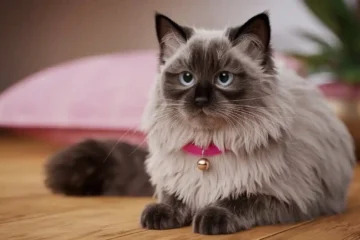
A Seal Point Ragdoll cat has deep seal-brown coloring on its face, ears, legs, and tail, set against a lighter cream or pale fawn body. The contrast can look almost black in some lighting, and traditional Ragdolls have blue eyes. Seal describes the point color, while terms such as colorpoint, mitted, bicolor, and lynx describe the pattern or markings.
This guide explains how to identify a seal point Ragdoll, understand its pattern variations, and care for its coat and health. It also covers temperament, size, kitten color changes, breeder questions, and common questions people ask before bringing one home.
Seal Point Ragdoll Cat: Quick Facts
| Feature | What to Know |
|---|---|
| Breed | Ragdoll |
| Point color | Deep seal brown, sometimes appearing nearly black in dim light |
| Body color | Usually pale fawn to cream, with natural shading |
| Eyes | Blue in Ragdolls that meet the traditional pointed breed standard |
| Patterns | Colorpoint, mitted, and bicolor; lynx or tortie markings can also occur |
| Coat | Semi-long and silky, requiring regular combing |
| Temperament | Often affectionate and people-oriented, but individual personalities vary |
| Care priorities | Coat care, measured feeding, daily play, preventive veterinary care, and health screening |
Breed descriptions and color terminology in this guide are checked against the TICA Ragdoll Breed Profile and the Cat Fanciers’ Association Ragdoll Breed Standard.
What Is a Seal Point Ragdoll Cat?
Seal point is a color variety within the Ragdoll breed, not a separate breed. The word “points” refers to the face mask, ears, legs, and tail, where darker pigment develops. In a seal point Ragdoll, these areas are a rich brown shade while the torso is lighter.
Pointed coloring develops gradually because pigment production is temperature-sensitive. Ragdoll kittens are often born very pale, and their points become more visible as they grow. Their coat can continue to deepen as they mature, so a young kitten may look different from the same cat as an adult.
Seal point Ragdolls are usually recognized by their dark brown points, pale body, and blue eyes. The precise shade and contrast vary from cat to cat, and lighting or photographs can make the points look darker than they appear in person.
Seal points can be confused with Chocolate Point Ragdolls in photographs. Seal points are generally a deeper brown, while chocolate points are a warmer, lighter milk-chocolate shade. Lighting, age, and screen settings can affect how the colors appear.
Ragdolls are a large, slow-maturing breed. TICA lists adult males at around 15–20 pounds and females at around 10–15 pounds, although healthy weight depends on frame and body condition. Ask a veterinarian to assess a cat’s body condition rather than judging health by weight alone.
Other Ragdoll point colors include blue, chocolate, lilac, red, and cream. For a broader overview, read our Ragdoll Cat Colors and Patterns Guide.
Temperament & Intelligence of the Seal Point Ragdoll
Seal point Ragdolls do not have a separate personality simply because of their color. Many Ragdolls are affectionate, sociable, and interested in staying near their people. Some enjoy lap time, following family members, interactive games, or learning simple tricks, while others prefer affection on their own terms. If you are deciding whether your cat needs a feline companion, read our Guide to Whether Ragdoll Cats Need a Companion.
The popular claim that every Ragdoll goes limp when picked up is not a guarantee. Temperament depends on genetics, early socialization, health, and individual experience. Let the cat choose whether it wants to be held, and support its body when lifting it.
Are Seal Point Ragdoll Cats Good for Families?
Many Ragdolls can do well in family homes when children learn to approach calmly, support the cat’s body, and respect its need for space. Do not assume a cat will never scratch or bite. Supervise young children and provide a quiet area where the cat can retreat.
Can Seal Point Ragdolls Live With Other Pets?
They may adapt to other cats or cat-friendly dogs when introductions are gradual. Start with separate spaces, exchange scents, and allow short, supervised meetings. Provide separate food, water, resting areas, and litter resources so no animal has to compete.
Variations of Seal Ragdolls
It helps to separate the color from the pattern. “Seal” describes the deep brown point color. “Colorpoint,” “mitted,” and “bicolor” describe where white markings appear. Lynx refers to tabby-like stripes in the points, while tortie describes red or cream mottling. These markings can combine with the seal color.
Seal Colorpoint Ragdoll
A seal colorpoint has deep seal-brown points and a lighter body, without white markings. The face, ears, legs, and tail show the darker color. This is the classic pointed look many people picture when they hear “seal point Ragdoll.”
Seal Mitted Ragdoll
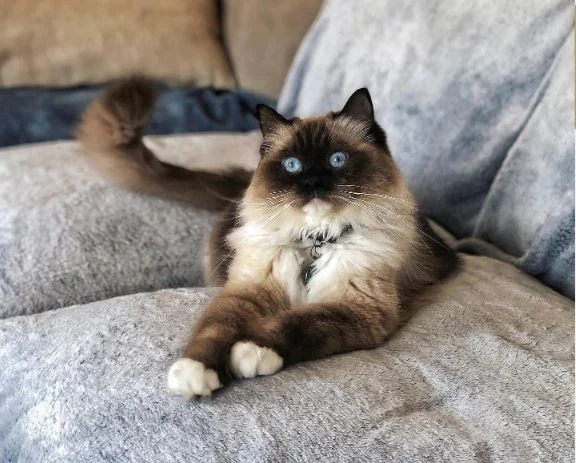
Seal Mitted Ragdolls have the same dark seal points as the Colorpoint but with additional white “mittens” on their front paws, white back legs, a white chin, and often a white belly stripe. The mitted look gives them a distinctive appearance compared to the standard Colorpoint.
Seal Bicolor Ragdoll
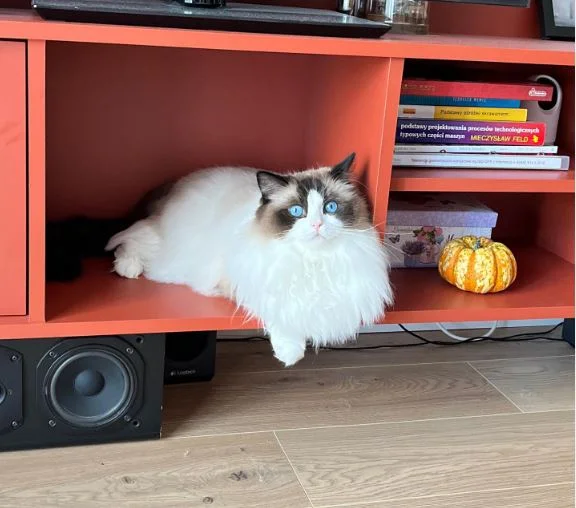
A seal bicolor generally has a prominent inverted white V on the face, along with white on the chest, legs, and underside. The distribution of white differs from the more limited white markings of a mitted Ragdoll. See our Ragdoll Cat Colors and Patterns Guide for a broader explanation of Ragdoll patterns.
Seal Lynx Point Ragdoll
A seal lynx point has tabby-like stripes or bars within the darker points, especially around the face and legs. Lynx describes the pattern of the points, while seal describes their brown color. A seal lynx pattern can occur with different white-marking patterns.
Seal Tortie Point Ragdoll
A seal tortie point has seal-brown points mottled with red or cream patches. The distribution varies, so no two tortie-point cats look exactly alike. Tortie coloring is more commonly seen in females because of the genetics involved, although rare exceptions can occur.
Seal Point vs Chocolate, Blue, and Lilac Ragdolls
| Color Variety | Typical Point Color | General Visual Difference |
|---|---|---|
| Seal Point | Deep seal brown | Dark, warm brown points against a pale fawn or cream body |
| Chocolate Point | Warm milk chocolate | Usually lighter and warmer brown than seal |
| Blue Point | Blue-grey | Cool grey points rather than brown |
| Lilac Point | Frosty grey with a pinkish tone | Paler, softer-looking points |
Photographs can make these shades difficult to distinguish because of lighting, white balance, age, and screen settings. If color classification matters for registration or showing, ask a reputable breeder or the relevant cat registry to confirm it rather than relying on a single photo. Our Flame Point Ragdoll Cat Guide covers another point-color variation.
Grooming, Shedding, and Coat Care
The seal color does not change the grooming routine. Ragdolls have a semi-long coat that benefits from regular combing to remove loose hair and prevent tangles, especially around the collar, under the front legs, and behind the hind legs.
- Comb the coat at least weekly, increasing frequency if tangles develop or during heavier shedding.
- Use a cat-safe comb and work gently without pulling the coat.
- Check for knots around the armpits, collar, belly, and hindquarters.
- Introduce nail care, tooth brushing, and carrier training in short, positive sessions.
- Never cut a tight mat close to the skin with household scissors. Ask a veterinary professional or experienced groomer for help.
Ragdolls shed, and no coat color makes a cat hypoallergenic. If someone in your household has cat allergies, spend time with the individual cat before adopting and consult a healthcare professional about symptoms and management.
Seal Point Ragdoll Health and Lifespan
Seal point coloring does not by itself indicate a different health profile from other Ragdolls. General care, inherited risk, body condition, dental health, preventive veterinary visits, and the cat’s living environment all matter. No breeder can guarantee a specific lifespan.
Hypertrophic Cardiomyopathy and Health Screening
Hypertrophic cardiomyopathy (HCM) is an important inherited heart condition in Ragdolls. Before choosing a kitten, ask the breeder what genetic testing and cardiac evaluations have been performed on the parents and how results are interpreted. A genetic test can help identify certain known variants, but it does not rule out every possible cause of HCM. Learn more from the Cornell Feline Health Center Guide to Hypertrophic Cardiomyopathy.
Ask for veterinary records, vaccination and parasite-treatment history, and details of any health problems in the kitten’s close relatives. For further reading, see our Guide to Common Ragdoll Health Problems.
Weight, Nutrition, and Daily Activity
Because Ragdolls are large and can be relaxed indoors, monitor body condition instead of feeding by appearance alone. Measure meals, follow a complete and balanced diet suitable for the cat’s age, keep fresh water available, and schedule daily interactive play. Your veterinarian can help set an appropriate weight and feeding plan.
Do Seal Point Ragdoll Kittens Change Color as They Grow?
Yes. Pointed kittens are often born very pale, and the seal color develops over time. Their face, ears, legs, and tail gradually become darker, while the body remains lighter. Coat color may deepen with maturity, so kitten photographs are not always a reliable picture of the adult coat.
Color development varies between individuals. If you are buying a kitten, ask the breeder for photos of related adult cats and a clear explanation of the kitten’s registered color and pattern, where applicable.
How to Choose a Seal Point Ragdoll Kitten
- Ask for the kitten’s veterinary records, vaccination information, and parasite-treatment history.
- Ask what health screening has been completed for the parents, including relevant HCM testing and cardiac evaluation.
- Meet the kitten or arrange a live video meeting, and observe how it responds to people and its environment.
- Request clear information about the breeder’s contract, return policy, and support after the kitten goes home.
- Avoid sellers who pressure you to pay quickly, refuse reasonable questions, or will not provide health documentation.
- Budget for food, litter, grooming tools, routine veterinary care, emergencies, and pet insurance if available.
Consider rescue and adoption as well as breeders. An adult cat may be a good option if you want a more established sense of its personality and grooming needs.
FAQs (Because People Keep Asking)
What Does Seal Point Mean in a Ragdoll Cat?
Seal point describes the deep brown color on the face, ears, legs, and tail. It does not identify a separate breed, and it is different from terms such as mitted or bicolor, which describe white-marking patterns.
Are Seal Point Ragdoll Cats Rare?
Seal is a recognized Ragdoll point color and is not inherently a rare or non-standard color. Availability depends on the breeder, region, pattern, and current litters.
Are Seal Point Ragdoll Kittens Born White?
They are usually born very pale, and their darker points develop as they grow. The timing and depth of color vary between kittens.
Do All Seal Point Ragdolls Have Blue Eyes?
Blue eyes are part of the traditional pointed Ragdoll breed standard. Eye color alone does not confirm pedigree, so use breeder records and registry documentation when that matters.
What Is the Difference Between Seal Point and Seal Mitted Ragdolls?
Both have seal-brown points. A seal mitted Ragdoll has specific white markings on the paws and chin, while a seal colorpoint has no white markings.
What Is the Difference Between Seal Point and Seal Bicolor?
Seal describes the point color. A seal bicolor Ragdoll has a larger amount of white, typically including an inverted white V on the face and white on the chest, legs, and underside.
Do Seal Point Ragdolls Get Darker With Age?
They can. Their points develop after birth, and the body coat may also become darker with maturity. The amount of change differs between individual cats.
Are Seal Point Ragdolls Hypoallergenic?
No cat breed is truly hypoallergenic. Ragdolls shed and produce allergens, so people with allergies should assess their own response to the individual cat before committing.
How Often Should I Brush a Seal Point Ragdoll?
Start with at least weekly combing and increase it when the coat tangles or shedding increases. Check friction areas such as behind the ears, under the front legs, and around the hindquarters.
What Health Problems Should I Ask a Breeder About?
Ask about the family’s health history and appropriate screening, including HCM-related genetic testing and cardiac evaluation. Request records and discuss individual health concerns with a veterinarian.
How Much Does a Seal Point Ragdoll Cost?
Prices vary by location, breeder, pedigree, age, and whether the cat is sold as a pet or for breeding or showing. Compare current local prices, verify what the fee includes, and budget for ongoing veterinary and care costs instead of relying on one generic price estimate.
Editorial Note and Sources
This guide distinguishes point color from coat pattern and avoids treating color as a predictor of personality or health. Breed and color descriptions were checked against the TICA Ragdoll Breed Profile and the Cat Fanciers’ Association Ragdoll Breed Standard. Health information should be discussed with a qualified veterinarian. This article is educational and is not a substitute for individual veterinary advice.