
A Chocolate Ragdoll Cat has warm milk-chocolate brown points against a pale ivory body, with the vivid blue eyes expected of a standard pointed Ragdoll. The color is subtle but distinctive, and it can be easier to confuse with seal in young kittens or in photographs with warm lighting.
Last Updated: October 18, 2026. This guide explains how to recognize chocolate points, understand coat patterns and color development, and check a breeder’s claims before choosing a kitten.
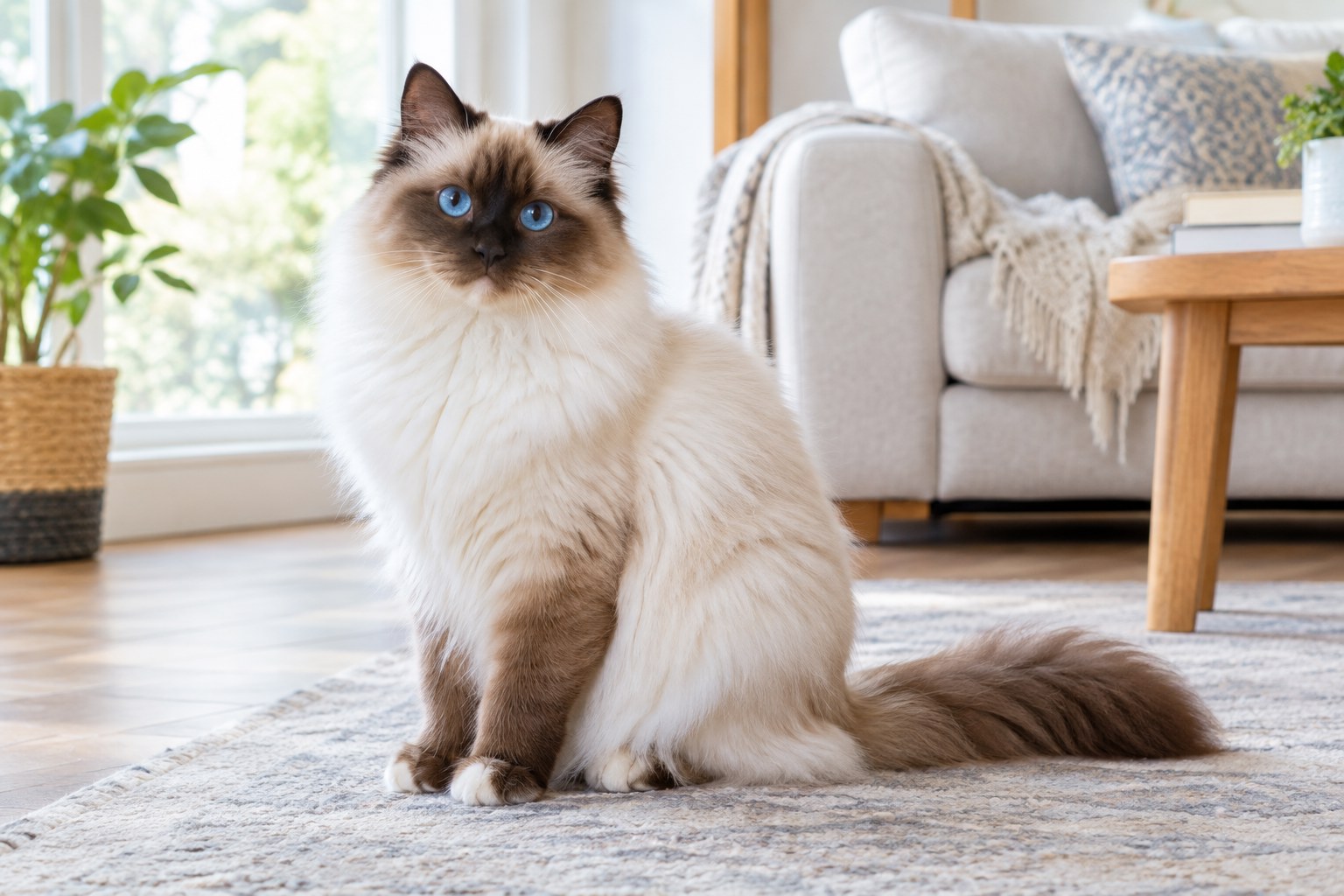
Here, “chocolate” describes the coat color, not a separate Ragdoll breed or a guaranteed personality type. Temperament, health, and suitability for a household depend on the individual cat, socialization, breeding, and care.
What Is a Chocolate Ragdoll Cat?
Chocolate is one of the recognized Ragdoll point colors. The points on the ears, face mask, legs, feet, and tail are a warm milk-chocolate brown, while the body is generally ivory or pale cream. Compared with a Seal Point Ragdoll Cat, chocolate points usually look lighter and warmer rather than deep seal brown. The Cat Fanciers’ Association describes chocolate points as warm milk-chocolate in tone, with blue eyes and cinnamon-pink nose leather and paw pads. See the CFA Ragdoll Breed Standard for the official description.
A chocolate point Ragdoll should have vivid blue eyes. Its nose leather and paw pads are typically cinnamon-pink in a colorpoint pattern; white markings in mitted or bicolor cats can change how the nose and paws appear. Look at the coat, pattern, pedigree, and breeder documentation together rather than relying on a single photo or paw-pad color.
Chocolate coloration is recessive: a kitten generally needs to inherit a chocolate-associated allele from each parent to express the color. A seal-colored parent may carry chocolate without showing it, so appearance alone cannot confirm what genes a cat carries. Ask the breeder for pedigree information and, where relevant, documented genetic testing rather than accepting a color claim without evidence.
Chocolate Ragdoll Kittens: How Their Color Develops
Ragdoll kittens are born very pale, and their point color develops over the first weeks and months. In a chocolate point kitten, the ears, face, legs, and tail gradually show warm brown coloring while the body remains much lighter. Color continues to mature as the cat grows, so a young kitten may not show the final contrast clearly.
Darker points, such as those on their ears, face, paws, and tail, become more prominent as they get older, especially in the classic color point pattern that chocolate Ragdolls are known for.
Ragdolls mature slowly, and their coat color can continue developing for roughly the first two to three years. The exact shade varies by individual, age, lighting, and coat condition, so no single age guarantees a specific final color.
Chocolate Ragdoll Colors and Coat Patterns
Chocolate describes the point color. Colorpoint, mitted, and bicolor describe the main white-marking patterns; lynx adds tabby striping, and tortie describes a mix of colors. These labels can combine, so a cat may be described as chocolate lynx mitted, for example.
| Term | What to Look For |
|---|---|
| Chocolate Point | Warm milk-chocolate points on a pale ivory body, without white markings |
| Chocolate Mitted | Chocolate points plus white front mittens, hind boots, and a white chin |
| Chocolate Bicolor | Chocolate points with more extensive white markings, commonly including an inverted white V on the face |
| Chocolate Lynx | Chocolate points with tabby-like stripes or bars |
| Chocolate Tortie | Chocolate points mottled with red and/or cream shades, usually in female cats |
1. Chocolate Point Ragdoll
A Chocolate Point Ragdoll has warm brown points on the ears, face mask, legs, feet, and tail, with a pale ivory body and no white spotting in the colorpoint pattern. Chocolate and seal are different point colors, so the terms should not be used interchangeably.
The points (the darker fur on the ears, face, paws, and tail) are a rich chocolate color, while the rest of the body stays lighter.
The nose leather and paw pads are typically a cinnamon-pink color, adding to the soft, warm look of this variety.
This pattern is similar to that of a Siamese cat, with the darker points creating a striking contrast against the lighter body.
2. Chocolate Bicolor Ragdoll
The Bicolor pattern is a mix of white and chocolate. In this pattern, the body is mostly white, but there are chocolate-colored patches on the ears, tail, and face, often forming a “V” shape on the face.
The Bicolor pattern makes the Chocolate Ragdoll look like they are wearing a white tuxedo with chocolate accents, giving them a very clean, striking look.
In a bicolor pattern, white covers more of the body, chest, legs, and underside, and the face commonly has an inverted white V. The exact shape and symmetry vary. Avoid assuming that one pattern is automatically healthier or better than another.
3. Chocolate Mitted Ragdoll
The Chocolate Mitted Ragdoll shares similarities with the Chocolate Point but features additional white markings.
These cats have white “mittens” on their front paws and white “boots” on their hind legs. They also have a white chin and sometimes a white belly stripe that runs from the chin to the tail.
The mitted pattern is defined by white front paws, white hind-leg boots, a white chin, and typically a white belly stripe. The amount and placement of white vary, so compare a kitten’s markings with the breed standard rather than using a seller’s label alone.
4. Chocolate Lynx Ragdoll cat
Chocolate Lynx Ragdoll, you’ll see chocolate points with lighter markings on the face, legs, and tail, which may look like stripes or swirls. They also have lighter spots around their eyes and cheeks.
The Lynx pattern adds a wildcat look to the Chocolate Ragdoll, with those subtle tabby markings making them stand out even more. The chocolate color combined with the tabby stripes makes them look like a little tiger!
Lynx markings can appear alongside other patterns, including colorpoint, mitted, and bicolor. In descriptions such as “chocolate lynx mitted,” chocolate names the point color, lynx names the tabby overlay, and mitted describes the white markings.
1. Chocolate Lynx Point Ragdoll cat
The Chocolate Point Lynx Ragdoll has the classic colorpoint pattern (dark chocolate on the ears, face, paws, and tail) along with tabby markings on the face, legs, and tail. These markings are subtle and lighter, like faint stripes or spots.
2. Chocolate Lynx Mitted Ragdoll
This variation has the same chocolate points and tabby markings as the regular Chocolate Lynx but with white mittens on their paws and a white chin. Some may also have a white spot on their belly, known as a “saddle.”
3. Chocolate Lynx Bicolor Ragdoll
Chocolate Lynx Bicolor Ragdolls have a white body with chocolate points on the ears, face, and tail, but they also have tabby-like markings on their face and limbs. The pattern often forms a “V” shape on their face, and their body is mostly white.
Bicolor Ragdolls, in general, are less common than other patterns. When combined with the Chocolate and Lynx tabby markings, it becomes even rarer. The white body combined with chocolate and tabby stripes creates a very unique look that’s not seen as often.
5. Chocolate Tortie Ragdoll
Chocolate Tortie Ragdoll, the mix is between chocolate brown and red or cream. This results in a marbled effect of dark chocolate and lighter reddish-brown shades.
Tortie Ragdolls are often described as having a “mosaic” of colors, with chocolate brown mixed with warm, reddish tones that can vary across their body. These cats are typically female, as the Tortie color pattern is linked to the X chromosome.
The tortoise pattern is random. So, no two Chocolate Tortie Ragdolls are alike.
6. What Does “Chocolate Mink” Mean?
Some breeders use the term mink for cats with a different coat appearance and genetic background. The term is not one of the three classic Ragdoll patterns listed by CFA, which are colorpoint, mitted, and bicolor. Registry rules can differ, so ask which association the breeder registers with and confirm how it classifies the cat.
A cat advertised as chocolate mink may have a more shaded or less sharply contrasted coat than a traditional chocolate point. Appearance alone does not establish pedigree or registry status, and online listings may use color terms inconsistently.
Do not pay a premium based only on the word “mink” or “rare.” Ask for registration paperwork, parent details, veterinary records, and a written contract, and verify any claims directly with the relevant registry.
7. Be Careful With “Solid Chocolate Ragdoll” Listings
A uniformly chocolate-colored, non-pointed cat does not match the classic Ragdoll standard. CFA describes Ragdolls as pointed, blue-eyed cats and lists chocolate as a point color, not as a solid all-over coat. If a seller advertises a “solid chocolate Ragdoll,” ask the registry to confirm the cat’s breed registration instead of relying on the listing title.
Coat color alone cannot prove that a cat is a registered Ragdoll. A cat may be a lovely companion without meeting a particular breed standard, but buyers should receive accurate information about its ancestry and registration.
Blue eyes are a defining feature of standard pointed Ragdolls. Green eyes are not the standard eye color for the breed, so treat claims that a green-eyed, solid-coated cat is a standard Ragdoll as a reason to ask more questions.
For official descriptions, compare the kitten with the TICA Ragdoll Breed Profile and the CFA Ragdoll Breed Standard. Both are more reliable than informal color labels in marketplace listings.
How to Find Chocolate Ragdoll Kittens for Sale
Finding Chocolate Ragdoll kittens for sale can be a bit challenging due to their specific and rare coloring. However, there are several reputable sources where you can begin your search:
1. Reputable Breeders
- Check Cat Registries: Start with the official International Cat Association (TICA) and Cat Fanciers’ Association (CFA) websites. Use their breeder resources where available, then independently check health records, registration documents, references, and the written contract. Registry membership alone is not a guarantee of ethical breeding.
- Ragdoll-Focused Breeders: Contact breeders who can explain their breeding goals, show registration and parent records, provide veterinary documentation, and let you ask questions before paying a deposit. Verify any directory independently and do not assume a listing guarantees breeder quality.
2. Online Pet Marketplaces
- Petfinder and Adopt a Pet can help you look for cats through shelters and rescue groups. Breed and color descriptions in adoption listings may be estimates, so ask what is known about the cat’s background.
3. Ragdoll Cat Associations and Clubs
- Ragdoll Fanciers Club International (RFCI): RFCI is dedicated to Ragdoll cats and may offer resources or breeder referrals for those seeking specific color patterns, including Chocolate Ragdolls.
- Local Ragdoll Clubs: Joining a local or regional Ragdoll club can provide access to breeder recommendations, upcoming litters, and possibly even show-quality Chocolate Ragdoll kittens.
4. Social Media and Online Communities
- Online Communities: Social media groups may help you learn about available litters, but treat posts as leads rather than endorsements. Verify the seller’s identity, visit in person or by live video, and never send a deposit before confirming the kitten, breeder, paperwork, and contract.
- Adoption and Rescue: Check reputable local shelters and rescue organizations if you are open to an adult cat or a cat without confirmed pedigree. Breed and color descriptions in rescue listings may be estimates rather than verified lineage.
Are Chocolate Ragdolls Rare?
Chocolate is a recessive color, so not every Ragdoll pairing can produce chocolate kittens. Availability depends on the cats’ genetics and the breeder’s program, but “rare” is not proof of quality and should not be used by itself to justify a high price. Ask for documentation supporting the kitten’s color and pedigree.
Chocolate vs. Seal Point Ragdoll: What Is the Difference?
The main difference is point color. Chocolate points are warm milk-chocolate brown, while seal points are a deeper seal brown that can look nearly black in some lighting. Both standard pointed varieties have blue eyes. For another color comparison, see our Blue Point Ragdoll Cat Guide and Ragdoll Cat Colors and Patterns Guide.
How Much Do Chocolate Ragdoll Kittens Cost?
There is no reliable universal price for a Chocolate Ragdoll kitten. Cost varies by country, breeder, pedigree, age, registration, veterinary care, and what is included in the contract. Request an itemized quote and compare health documentation, socialization, and breeder transparency rather than choosing by coat color or the lowest advertised price.
How Long Do Chocolate Ragdolls Live?
Ragdolls can live into their mid- or late teens, but lifespan varies with genetics, preventive care, diet, indoor safety, and individual health. Ask the breeder about family health history and discuss routine wellness checks with your veterinarian. Breed-specific color does not determine lifespan.
Chocolate Ragdoll Personality and Care
Chocolate is a coat color, not a personality category. Ragdolls are commonly described as sociable and people-oriented, but individual cats vary. Ask about the kitten’s behavior, early handling, exposure to household sounds, and comfort around people rather than assuming every Ragdoll will behave the same way.
Grooming and Coat Care
- Comb the semi-long coat several times a week, increasing attention if you notice tangles around the armpits, ruff, or hindquarters.
- Check the coat and skin while grooming, and introduce brushing gently so it becomes a calm routine.
- Keep nails trimmed, provide scratching surfaces, and ask your veterinarian about dental care and ear cleaning if needed.
- Use a complete, balanced cat food appropriate for the cat’s age and measure portions to help maintain a healthy body condition.
- Provide fresh water, daily play, climbing or scratching options, and safe indoor enrichment.
Health Questions to Ask a Breeder
Ask about the parents’ health history and screening for hypertrophic cardiomyopathy (HCM), a heart condition relevant to Ragdolls. Request records rather than relying on verbal assurances. A negative result or a parent’s screening cannot guarantee that a kitten will never develop a health problem. Review concerns with your veterinarian and consult the Cornell Feline Health Center’s HCM Guide.
Chocolate Ragdoll Kitten Buying Checklist
Before placing a deposit, work through this checklist:
- Confirm the breeder’s registration and the kitten’s pedigree with the relevant registry.
- Ask for the kitten’s veterinary records, vaccination and parasite-treatment history, and a written health guarantee or contract.
- Ask what health screening was completed for the parents and request copies of results.
- Meet the kitten and, where possible, see the mother and the environment where the litter is raised.
- Ask how the breeder identifies chocolate versus seal coloring and whether the kitten’s color is confirmed or still developing.
- Read the return policy and understand what happens if a serious health issue is identified.
- Be cautious of pressure to pay immediately, unusually low prices, copied photos, or sellers who refuse a video call or documentation.
FAQs (Because People Keep Asking)
1. Do Chocolate Ragdoll Cats Have Blue Eyes?
Yes. Standard pointed Ragdolls have blue eyes, including chocolate points. A listing that describes a solid-coated, green-eyed cat as a standard Ragdoll should be verified with the relevant registry.
2. How Can I Tell a Chocolate Ragdoll From a Seal Ragdoll?
Chocolate points are generally warm milk-chocolate brown, while seal points are deeper and darker brown. Young cats, lighting, and photographs can make the colors harder to distinguish, so check pedigree information and compare several features.
3. Are Chocolate Ragdoll Kittens Born Brown?
No. Ragdoll kittens are born very pale, and their point color becomes clearer as they grow. The coat can continue changing for the first few years.
4. Are Chocolate Ragdolls Rare?
Chocolate is recessive, so its availability depends on the parents’ genetics and the breeder’s program. Rarity alone does not indicate better health, temperament, or pedigree quality.
5. How Much Does a Chocolate Ragdoll Cost?
Prices vary by location, breeder, pedigree, registration, age, and included veterinary care. Ask for an itemized quote and compare records and contract terms instead of relying on a universal price range.
6. Are Solid Chocolate Ragdolls Recognized?
Classic Ragdoll standards describe a pointed, blue-eyed cat. CFA lists chocolate as a point color, not an all-over solid coat. If a seller uses “solid chocolate Ragdoll,” verify the cat’s registration and ancestry directly with the named registry.
7. What Is a Chocolate Mink Ragdoll?
“Mink” is used by some breeders for a different-looking coat or genetic line, but it is not one of the three classic patterns listed by CFA. Ask which registry applies and how the cat is recorded before treating the term as an official classification.
8. How Long Do Ragdoll Cats Live?
Many Ragdolls live into their mid- or late teens, although lifespan varies. Routine veterinary care, genetics, nutrition, and a safe environment all matter.
Related Ragdoll Guides
- Ragdoll Cat Colors and Patterns Guide
- Seal Point Ragdoll Cat Guide
- Blue Point Ragdoll Cat Guide
- Cream Point Ragdoll Cat Guide
- Flame Point Ragdoll Cat Guide
- Lilac Ragdoll Cat Guide
Editorial Note and Sources
This article is an informational breed guide, not a veterinary diagnosis or a substitute for reviewing a kitten’s actual records. Breed-color descriptions were checked against the TICA Ragdoll Breed Profile and the CFA Ragdoll Breed Standard. Health questions should be discussed with a qualified veterinarian.
Editorial Review: Abdul Khader. This guide focuses on explaining coat-color terminology, breeder documentation, and everyday care. It does not claim hands-on testing of a specific kitten or breeder.