Last updated: October 18, 2026
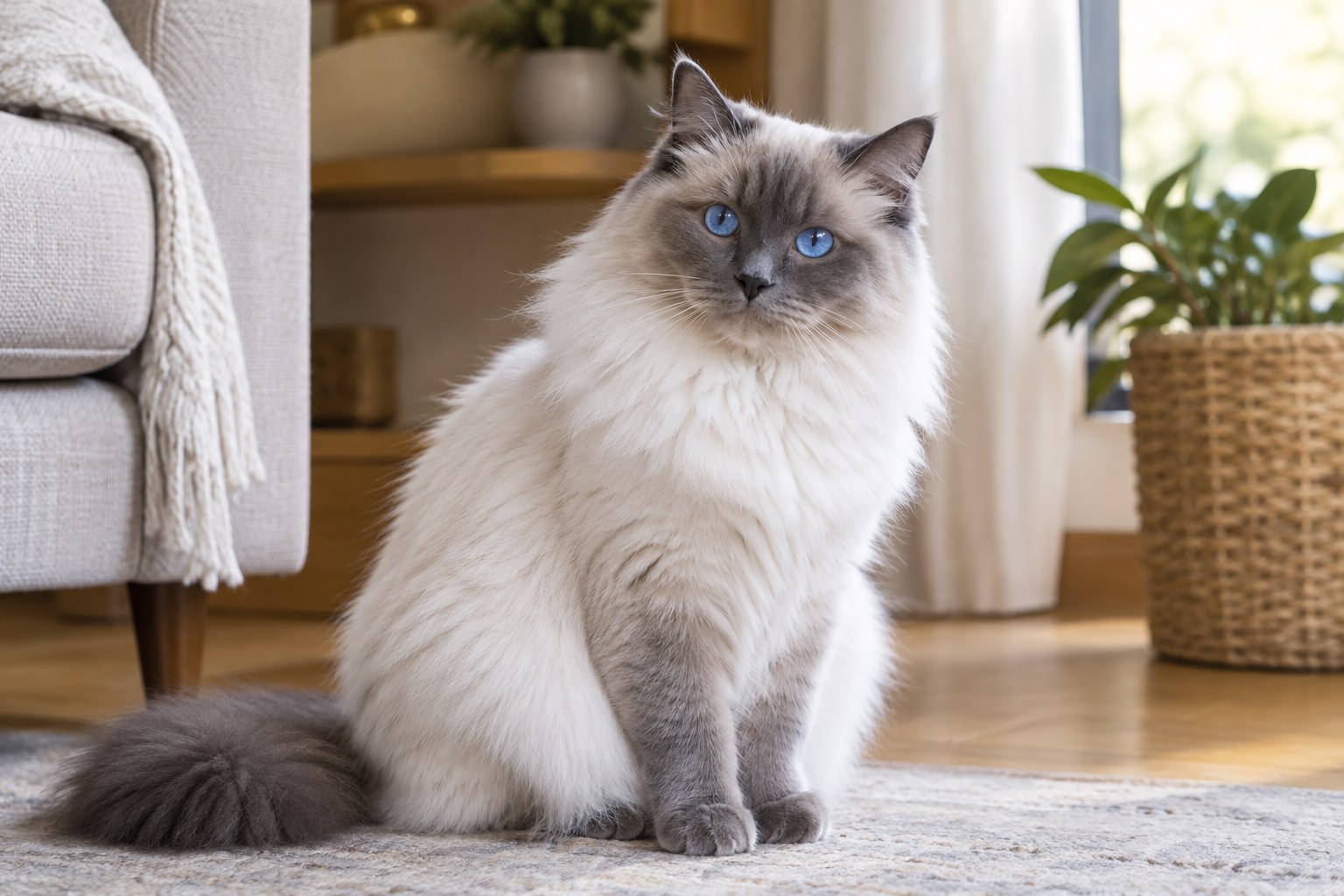
A Blue Point Ragdoll Cat has a pale, usually bluish-white body with cooler gray-blue coloring on its face, ears, legs, and tail. “Blue” describes a diluted gray shade rather than a bright blue coat. This guide explains how to identify the color, tell colorpoint markings from mitted and bicolor patterns, understand kitten color changes, and care for a Ragdoll responsibly.
Blue Point Ragdoll: Breed Overview
Here’s a concise overview of the Blue Point Ragdoll Cat breed in a table format:
| Feature | Description |
|---|---|
| Origin | United States |
| Size | Large |
| Weight | 10-20 pounds |
| Coat Color | Blue-gray points with lighter body |
| Coat Type | Semi-long, plush fur |
| Eye Color | Blue |
| Temperament | Gentle, affectionate, relaxed |
| Activity Level | Low to moderate |
| Lifespan | 12-17 years |
| Grooming Needs | Moderate |
| Health Concerns | Heart issues, HCM |
| Suitable for | Families, singles, indoor living |
| Special Features | Floppy, relaxed posture when held |
What Is a Blue Point Ragdoll Cat?
A Blue Point Ragdoll is a type of Ragdoll cat. The term “Blue Point” refers to the coloring of the Ragdoll’s fur. “Blue” in this context doesn’t mean the color blue but rather a diluted version of gray, usually lighter than other colors like Seal Point Ragdoll or chocolate Ragdoll. The points, which are the darker areas on their ears, face, paws, and tail, stand out in a soft, subtle blue-gray. Like all Ragdoll cats, the Blue Point Ragdoll cat has striking, large blue eyes
The Ragdoll breed is officially recognized by the Cat Fanciers’ Association (CFA) and the International Cat Association (TICA) in six different colors: seal, blue, chocolate, lilac, flame, and cream. Blue is identified as one of the official Ragdoll colors, although it’s a very common color of the Ragdoll breed.
Blue Point Ragdoll Kittens
Blue Point Ragdoll kittens are born very pale, and their point color develops over the following weeks. The ears, face, legs, and tail gradually show more gray-blue shading. A newborn’s coat is not a reliable guide to its final adult appearance, so ask the breeder for updated photos and information about the kitten’s parents.
The blue points often become easier to see during the first few months, but development varies from cat to cat. Blue points should look like cool gray or slate rather than black. Ragdolls mature slowly, and coat shade can continue to deepen as they grow older. Avoid relying on a fixed age to predict the exact adult shade.
Ragdoll coat color develops gradually, and the breed may take several years to reach its mature appearance. Blue refers to the dilute gray point color; it is different from lilac, which is generally a paler, pinkish-gray shade. Lighting, photography, age, and individual genetics can affect how a coat looks, so use breed-standard descriptions rather than a single photo to identify the color.
The Personality of Blue Point Ragdolls
Ragdolls are often described as affectionate and people-oriented, but a cat’s personality depends on its individual temperament, early experiences, and environment. Blue coloring does not determine personality, and no cat should be assumed to tolerate every situation or handling style.
Many Ragdolls can adapt well to family life when introductions are gradual and interactions are respectful. If children or other pets live in the home, supervise early interactions and provide the cat with quiet places to retreat. Some Ragdolls are outgoing, while others need more time and space to feel secure.
They will give you lots of love and attention – this is the type of cat that will sleep in your bed or curl up next to you while you watch TV.
These cats love to play but are not too crazy. They enjoy playing with toys like balls or feathers. However, they don’t play all day long. After some playtime, they need to rest and relax.
Blue Point Ragdolls are intelligent cats. If you teach them, they can learn tricks like “sit” or “high five.” They love to spend time with you, so they will enjoy learning new things. These felines are trainable, but they do not need to be trained all the time. They are happy to learn when they are in the mood, especially if you give them treats for doing a great job!
Things to Know When Owning a Blue Point Ragdoll
Here are the key things to know when owning a Blue Point Ragdoll cat:
Food and Diet Requirements
Blue Point Ragdolls, like all cats, need a complete and balanced cat food appropriate for their age and health. Choose a food labelled as nutritionally complete for the relevant life stage rather than trying to build a diet from individual meats alone. Ask your veterinarian for advice if your cat has a medical condition or special dietary needs.
Wet food can contribute to daily water intake, while dry food may also be appropriate depending on the cat’s needs. Keep clean drinking water available at all times. No single food format is best for every cat, so consider nutritional completeness, life stage, body condition, preferences, and veterinary guidance.
Measured meals or a veterinarian-approved feeding plan can help you monitor intake and body condition. Avoid leaving unlimited food out if your cat tends to overeat. Adjust portions to age, activity, body condition, and the food’s feeding guidance, and reassess weight with your veterinarian.
Grooming a Blue Point Ragdoll
A Ragdoll’s semi-long coat benefits from gentle combing several times a week, with extra attention behind the ears, under the legs, and around the hindquarters where tangles can form. Grooming needs vary by coat and season. Trim nails when needed, using cat-safe clippers and care not to cut the quick.
Check the ears regularly, but do not clean deep inside or use air cleaners, cotton swabs, or unapproved products. Clean only as advised by your veterinarian. Daily tooth brushing with cat-specific toothpaste is ideal when tolerated; introduce it gradually and ask your veterinarian about dental checks.
Don’t forget to scoop the litter box daily and change it regularly to keep it fresh and make sure your cat has a clean place to go.
Training and Enrichment
Blue Point Ragdolls are intelligent cats. They can learn tricks, such as fetch, and even walk on a leash, although they are not as trainable as dogs.
Exercise
Offer daily interactive play using wand toys, soft balls, puzzle feeders, and climbing or scratching areas. Several short sessions can work better than one long session, depending on your cat’s age and energy level. If you use a laser toy, finish with a physical toy the cat can catch to avoid frustration.
Despite their easy-going nature, they can also be taught to enjoy walks on a harness for extra exercise.
Blue Point Ragdoll Health Considerations
Coat color does not make a Ragdoll more or less healthy. Ask a breeder about screening for hypertrophic cardiomyopathy (HCM), a heart condition relevant to the breed, and request documentation of the parents’ results. Genetic testing can identify some known variants but does not rule out every possible case of HCM. Your veterinarian can explain appropriate screening and ongoing health checks. Read the Cornell Feline Health Center’s HCM Guide for background.
Ask for the kitten’s veterinary records, vaccination and parasite-treatment history, and the breeder’s documented health-screening information for the parents. No screening result can guarantee that a kitten will never become ill, so routine veterinary care remains important. Avoid sellers who refuse to answer questions or pressure you to pay before you can verify the kitten’s welfare and records.
Blue Point Ragdoll Appearance at a Glance
| Feature | Typical Appearance |
|---|---|
| Point color | Cool gray-blue or slate blue |
| Body coat | Pale bluish white, often lighter on the chest and stomach |
| Points | Face, ears, legs, feet, and tail |
| Eyes | Blue in traditional pointed Ragdolls |
| Colorpoint pattern | Colored points without white markings |
| Mitted pattern | White mittens, hind-leg boots, chin, and belly stripe |
| Bicolor pattern | More extensive white, often including an inverted white V on the face |
| Coat development | Points develop after birth and may deepen with age |
Blue Point vs Blue Mitted vs Blue Bicolor Ragdoll
Blue describes the point color; the pattern describes where white markings appear. A blue colorpoint Ragdoll has no white spotting in the recognized colorpoint pattern. A blue mitted Ragdoll has white paws, a white chin, and a white underside stripe. A blue bicolor Ragdoll usually has more extensive white markings, including an inverted white V on the face. Pattern names can be combined with color names, so a blue Ragdoll is not automatically a colorpoint.
For the full range of coat descriptions, see our Ragdoll Cat Colors and Patterns Guide. You can also compare this color with our Seal Point Ragdoll Cat Guide and Cream Point Ragdoll Cat Guide.
Choosing a Blue Point Ragdoll Kitten
- Ask for veterinary records and vaccination and parasite-treatment history.
- Ask what health screening has been performed on the parents and request the documented results.
- Observe the kitten’s living conditions and behavior, in person or through a live video call.
- Ask about socialization, diet, litter habits, and how the kitten is transitioning to solid food.
- Review the contract, return policy, and the breeder’s ongoing support.
- Choose for welfare and temperament, not point color alone.
Blue Point Ragdoll Health and Routine Care
Schedule routine veterinary examinations, keep vaccinations and parasite prevention current according to professional advice, and monitor appetite, weight, mobility, coat condition, and litter-box habits. Contact a veterinarian if you notice a persistent change in breathing, energy, eating, drinking, or urination. The color of the coat is not a substitute for a health assessment.
FAQs (Because People Keep Asking)
What is a Blue Point Ragdoll Cat?
It is a Ragdoll with cool gray-blue points on a lighter body. “Blue” refers to the coat’s diluted gray shade, not a bright blue pigment.
Are Blue Point Ragdolls actually blue?
No. The points are generally slate or gray-blue. The name is a traditional cat-coat color term.
Do Blue Point Ragdolls have blue eyes?
Traditional pointed Ragdolls have blue eyes under major breed standards. If a cat’s identity or eye color concerns you, consult a qualified breeder or veterinarian rather than relying on coat color alone.
Are Blue Point and Blue Mitted Ragdolls the same?
They share the blue point color but differ in pattern. Mitted Ragdolls have distinctive white paws, a white chin, and a white underside stripe; a colorpoint pattern has no white markings.
Do Blue Point Ragdoll kittens change color?
Yes. Their points develop after birth and may deepen as they mature. The timing and final shade vary by cat.
Are Blue Point Ragdolls good family pets?
Many are sociable and affectionate, but individual personalities differ. Introduce children and other pets gradually, supervise interactions, and give the cat a quiet place to retreat.
How often should I groom a Blue Point Ragdoll?
Gentle combing several times a week is a practical starting point. Adjust the routine to the coat, shedding, and any tendency to develop mats.
What health tests should I ask a Ragdoll breeder about?
Ask about screening for hypertrophic cardiomyopathy and request documented results for the parents. A veterinarian can explain the limits of genetic testing and the need for ongoing care.
Breed References and Editorial Note
This article is for general breed education and does not replace veterinary advice. For recognized coat colors and pattern descriptions, consult the TICA Ragdoll Breed Profile and the CFA Ragdoll Breed Standard. For health concerns, consult a licensed veterinarian.
Conclusion
A Blue Point Ragdoll may suit a home looking for a people-oriented companion, provided its individual needs and temperament fit the household. No breed or coat color guarantees a particular personality, so spend time learning about the cat and plan for daily play, grooming, routine veterinary care, and a safe home environment.
If you are considering adopting a Blue Point Ragdoll, ask a responsible breeder or rescue organization for veterinary records and clear information about the cat’s background. You can also read the Guide to Finding a Reputable Cat Breeder. Health checks cannot guarantee a lifetime free of illness, but transparent records and ongoing veterinary care help you make a better-informed decision.