
If you have ever mixed up a Birman and a Ragdoll in a photo, you are in good company. Both are large, semi-longhaired cats with striking blue eyes and a calm, affectionate reputation, and at a glance they can look almost identical. This guide covers every real difference between them, from the one physical feature that tells them apart with near certainty, to temperament, grooming, health, and price, so you can tell them apart at a glance and decide which one actually fits your home.
Published September 2026.
Birman vs Ragdoll Cat Comparison
Before going deep into every detail, here is the quick version side by side:
| Trait | Birman | Ragdoll |
|---|---|---|
| Size | Medium, males 6-12 lbs | Large, males 12-20 lbs |
| Head shape | Round | Wedge-shaped |
| Eyes | Small, rounded | Large, oval |
| White paws | Always present (breed standard) | Only in the mitted pattern |
| Coat | Silky, minimal to no undercoat | Soft, minimal undercoat |
| Tail | Medium length | Long |
| Activity level | Playful, active into adulthood | Calm, less active as adults |
| Time to full maturity | Faster than Ragdoll | Up to 4 years |
| Origin | Documented from 1920s France | 1960s California, USA |
Origin and History
Birman Cat Origin
The Birman’s origin story carries real legend with it. Traditional accounts describe Birmans as sacred temple companions to Kittah priests in Myanmar, formerly known as Burma, with a myth that a priest’s soul passed into his cat upon death, explaining the breed’s golden coloring and white paws. It is a beautiful story, but breed historians are clear that there is no verified evidence connecting the breed to Burma. What can actually be documented is that the Birman breed was established in France in the 1920s, and the cats were later brought to the United States in the 1960s.
Ragdoll Cat Origin
The Ragdoll was developed in California in the 1960s by breeder Ann Baker, starting with a white longhaired female named Josephine, whose kittens showed an unusually relaxed, docile temperament. Baker bred Josephine’s kittens with several other cats, and some accounts describe a Birman-type or Birman-like tom among them, though the exact documented parentage is disputed among breed historians since Baker’s own records were inconsistent. What is not disputed is the temperament she selected for, which defines the breed today. The name Ragdoll comes directly from that behavior, the tendency to go floppy and relaxed when picked up.
Physical Differences Between Birman and Ragdoll Cats
Body Size and Build: The Most Immediately Visible Difference
Size is the fastest way to separate the two breeds side by side. Ragdolls are one of the largest domestic cat breeds, with males commonly reaching 12 to 20 pounds and females 8 to 15 pounds. Birmans are noticeably smaller, a medium to medium-large breed, with males typically weighing 6 to 12 pounds and females a bit less. A fully grown Ragdoll next to a fully grown Birman looks like a genuinely different size class of cat, not just a slight variation.
Face and Head Shape
Ragdolls have a wedge-shaped head with a gentle nose curve, while Birmans have a rounder head with a Roman-shaped nose that carries a slight indentation. Ragdoll eyes are large and oval. Birman eyes are smaller and more rounded. Ear placement differs too, Ragdolls have wide-set, medium-sized ears, while Birman ears are comparatively smaller.
The White Gloves: The Single Most Reliable Identifier
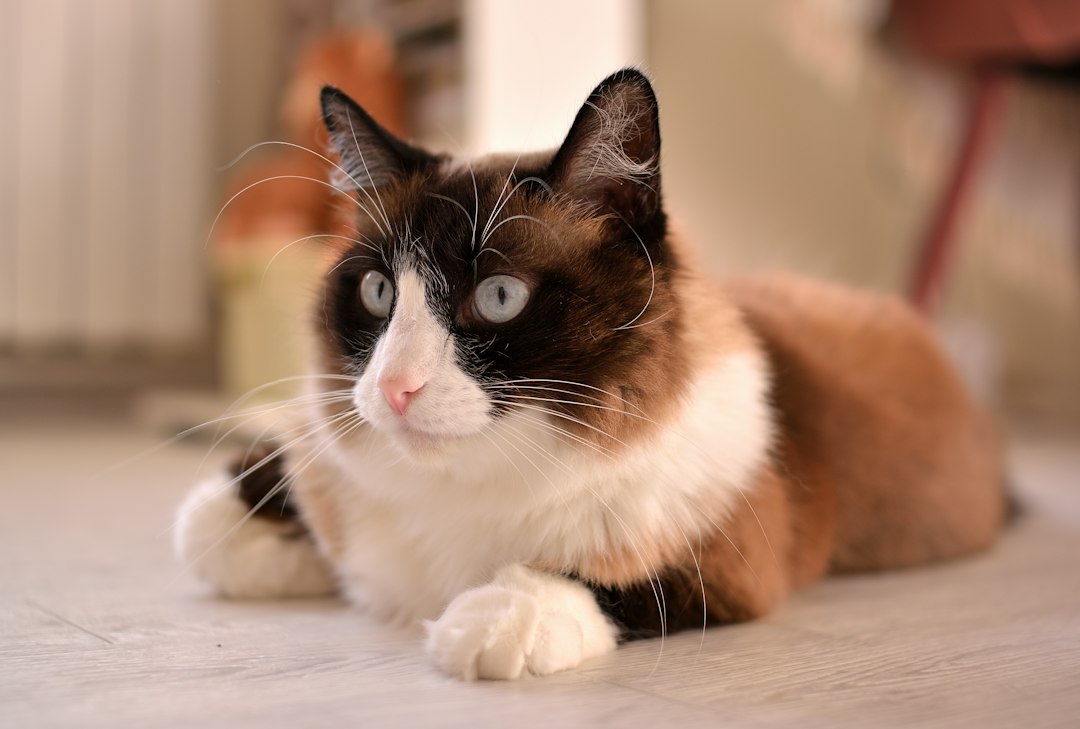
If you only remember one physical difference, make it this one. Every purebred Birman has white paws, often called gloves, on all four feet, and this is a strict, non-negotiable requirement of the breed standard. There is no colorpoint Birman without white paws.
Ragdolls are different. White paws only appear in the mitted Ragdoll pattern, explained in full in our Blue Mitted Ragdoll Cat guide. Colorpoint and bicolor Ragdolls have no white paw markings at all. This means if you see a cat with symmetrical, consistent white gloves on all four paws, you are very likely looking at a Birman. If the cat has colorpoint fur with no white paws whatsoever, it cannot be a Birman, and is either a colorpoint Ragdoll or a different breed entirely.
Coat Texture
Both breeds have semi-long, silky fur, but the texture differs in a way that affects grooming. The Birman’s coat has little to no undercoat and lies naturally flatter against the body, which is part of why Birmans mat less than many other longhaired breeds. Ragdolls also have a minimal undercoat, giving a soft, plush texture, though many owners describe it as slightly less silky and more prone to static than a Birman’s coat.
Tail Length
Ragdolls have proportionally long, full tails. Birman tails are medium in length, another subtle but real difference visible when the two breeds are compared side by side.
Coat Colors and Patterns
Birmans come exclusively in pointed colors, seal, blue, chocolate, lilac, red, and cream among them, always paired with the required white gloves. Ragdolls come in a wider range of patterns, including colorpoint, mitted, bicolor, and van, across the same general color palette. This is part of why an untrained eye can confuse the two, since the base point colors overlap heavily between the breeds.
Birman vs Ragdoll Personality
Ragdoll Personality
Ragdolls are famous for an exceptionally docile, easygoing temperament, often described as dog-like in their devotion and willingness to be handled. They tend to be calmer and less physically active as they mature, content to follow their owners around the house rather than seek out constant play. Because Ragdolls tend to trust any animal or person without much caution, they are generally recommended as strictly indoor cats.
Birman Personality
Birmans are affectionate lap cats too, but they carry a noticeably more playful, socially demanding energy that persists throughout adulthood rather than mellowing out the way a Ragdoll’s does. Birmans tend to form especially strong bonds with one or two favorite people in the household, and they are more likely to actively seek out interaction and play rather than simply being present.
Birman vs Ragdoll Personality: The Core Distinction
If you want it in one sentence: a Ragdoll’s calm is more constant and predictable across its adult life, while a Birman’s affection comes with more ongoing playfulness and a stronger preference for specific favorite people. Neither is more affectionate than the other, the difference is in energy level and how that affection is expressed day to day.
Birman vs Ragdoll Size Comparison
Restating the size difference in personality context matters here, since a large, extremely relaxed Ragdoll physically fills a lap differently than a smaller, more energetic Birman does. If you want a cat that mostly lounges, the Ragdoll’s size and temperament combination delivers that most reliably. If you want a cat that stays playfully engaged well into adulthood, the Birman’s temperament is the more consistent bet, regardless of size.
Birman vs Ragdoll Grooming
Brushing and Coat Maintenance
Both breeds are relatively low-maintenance for longhaired cats, thanks to their minimal undercoats, but Birmans generally need slightly less work. Brushing two to three times a week is typically sufficient for a Birman, since the coat lies flat and resists matting well. Ragdolls benefit from a similar two to four times weekly brushing schedule, with slightly more attention needed during spring and fall shedding season, covered in more depth in our guide on hairballs in Ragdoll cats.
Bathing and General Hygiene
Neither breed requires frequent bathing. Both are effective self-groomers and typically only need an occasional bath, mainly around shows or if they get into something messy. Routine nail trims, ear checks, and dental care matter equally for both breeds and are not affected by which one you choose. Our Ragdoll Cat Dental Care guide covers a routine that works for either breed.
Birman vs Ragdoll Health and Lifespan
Both breeds have a similar general lifespan, typically in the range of 12 to 16 years with good care. Both breeds are also associated with an elevated risk of hypertrophic cardiomyopathy (HCM), a serious heart muscle condition, though the specific genetic mutation identified in Ragdolls (MYBPC3 R820W) has been studied more extensively than any equivalent finding in Birmans. Our HCM in Ragdoll Cats guide covers genetic testing, staging, and treatment in full detail, and much of that guidance on screening and monitoring applies to Birman owners as a general precaution as well, even without a Birman-specific identified mutation. Ragdolls also carry a smaller documented risk of polycystic kidney disease, covered in our PKD in Ragdoll Cats guide. Whichever breed you choose, routine veterinary checkups and, ideally, a baseline cardiac screening are reasonable standards to expect from any breeder.
Birman vs Ragdoll Price
Ragdoll kittens from a reputable, health-tested breeder commonly range from around 1,200 to 2,500 dollars, with rarer colors sometimes priced higher. Birman kittens are generally in a broadly similar range, though the breed’s smaller population of dedicated breeders in some regions can push prices up due to limited availability rather than higher inherent demand. In both cases, price alone is not proof of health testing or authentic pedigree, always ask for documentation on both parents regardless of which breed you are considering.
Birman vs Ragdoll vs Himalayan: Three-Way Comparison
A third breed often enters this comparison because of the similar coloring: the Himalayan, a Persian-type breed with the same colorpoint pattern. The Himalayan is easy to rule out visually, since it has the flat, brachycephalic face typical of Persians, unlike the rounder (Birman) or wedge-shaped (Ragdoll) faces of the other two. Himalayans are also considerably smaller and less active than Ragdolls, and their flat face brings its own set of breathing and eye-care considerations that neither the Birman nor the Ragdoll shares. If the cat you are looking at has a pushed-in, flat face, you are looking at a Himalayan, not a Birman or a Ragdoll, regardless of coat color or point pattern.
Which Breed Is Better for You?
Choose a Ragdoll if you want the largest, calmest possible lap cat, a temperament that stays relaxed into adulthood, and you do not mind an especially trusting cat that needs to stay strictly indoors.
Choose a Birman if you want a slightly smaller, still deeply affectionate cat that stays playful and socially engaged throughout its life, and you like the idea of a cat that bonds especially closely with one or two favorite people.
Neither breed is objectively better, the right choice depends on how much size and activity level matter to your household and daily routine.
What We Have Covered
This guide walked through the origin of both breeds, the physical differences that actually let you tell them apart (most reliably, the Birman’s universal white gloves), the real personality distinction between a Ragdoll’s constant calm and a Birman’s persistent playfulness, grooming and health considerations that are broadly similar between the two, honest pricing expectations, and how a third breed, the Himalayan, fits into this comparison. If you remember nothing else, remember the paws: every Birman has them, only mitted Ragdolls do.
Frequently Asked Questions About Birman vs Ragdoll Cats
What is the difference between a Birman and a Ragdoll
The most reliable difference is size and the white paws. Ragdolls are considerably larger and only show white paws in the mitted pattern. Birmans are medium-sized and always have white paws on all four feet, regardless of point color.
Are Birman cats bigger than Ragdolls
No. Ragdolls are the larger breed, with males reaching up to 20 pounds compared to a Birman male’s typical 6 to 12 pounds.
Do Birman cats have white paws like Ragdolls
Birmans always have white paws, it is a strict breed standard requirement. Ragdolls only have white paws in the mitted pattern, colorpoint and bicolor Ragdolls do not have them.
Which is friendlier, Birman or Ragdoll
Both breeds are considered highly affectionate. Ragdolls express this through constant, calm devotion, while Birmans express it through more active, playful engagement, especially with one or two favorite people.
Some accounts of the Ragdoll’s early development mention a Birman-type cat among the breed’s foundational cats, though the exact documented parentage is disputed among breed historians. They are considered separate, independently recognized breeds today.
Which cat sheds more, Birman or Ragdoll
Both breeds have a minimal undercoat and shed less than double-coated longhaired breeds. Shedding levels are broadly comparable between the two, with individual variation mattering more than breed alone.
Related Topics and Search Terms Covered in This Guide
Secondary Keywords: Birman Cat Vs Ragdoll, Ragdoll Vs Birman Differences, Birman Ragdoll Comparison, Birman Cat Characteristics, Ragdoll Cat Characteristics, Birman Vs Ragdoll Size.
Related Keywords: Birman Cat Breed Standard, Ragdoll Cat Breed Standard, Birman Cat Temperament, Ragdoll Cat Temperament, Himalayan Cat Comparison, Colorpoint Cat Breeds.
Semantic (LSI) Keywords: White Gloves Birman Cat, Wedge-Shaped Head Ragdoll, Mitted Ragdoll Pattern, Semi-Longhair Cat Breeds, Hypertrophic Cardiomyopathy In Cats, Blue Eyes Colorpoint Gene, Temple Cat Legend.
Long-Tail Keywords: How To Tell A Birman From A Ragdoll Cat, Which Is Bigger Birman Or Ragdoll, Is A Birman Cat Friendlier Than A Ragdoll, Birman Vs Ragdoll Vs Himalayan Differences, Which Cat Breed Is Easier To Groom Birman Or Ragdoll.
Question-Based Keywords (People Also Ask): What Is The Difference Between A Birman And A Ragdoll. Are Birman Cats Bigger Than Ragdolls. Do Birman Cats Have White Paws Like Ragdolls. Which Is Friendlier, Birman Or Ragdoll. Is A Birman Related To A Ragdoll. Which Cat Sheds More, Birman Or Ragdoll.
Sources and Further Reading
- The Cat Fanciers’ Association (CFA) – Birman and Ragdoll Breed Standards
- The International Cat Association (TICA) – Birman and Ragdoll Breed Standards
- Catster (Vet-Reviewed) – Birman vs Ragdoll: The Differences
This article is for general informational purposes and is not a substitute for advice from a licensed veterinarian, particularly regarding HCM screening. This guide will be reviewed and updated periodically as breed standards and research evolve.
Final Thoughts
Side by side, a Birman and a Ragdoll can look confusingly similar in a photo, but in person the size difference alone usually settles it, and the paws settle any remaining doubt. Both breeds reward an owner looking for an affectionate, people-oriented cat, the real decision comes down to whether you want a Ragdoll’s especially large, calm presence or a Birman’s slightly smaller, more playfully engaged companionship. Either way, you are choosing between two of the most genuinely gentle cat breeds available.
Have you owned both a Birman and a Ragdoll. Share which one surprised you more in the comments.