If you’ve ever looked into a Ragdoll’s eyes and felt like you were staring into a calm, deep ocean, you’re not alone. That’s one of the things that makes this breed so addictive. But here’s what a lot of new Ragdoll owners don’t realize: not every Ragdoll has the same eye color, and those eyes can change quite a bit during the first year of life. The ragdoll eye color chart is more than just a pretty reference guide.
Last updated September 2026: we corrected an outdated claim about TICA and non-blue-eyed Ragdolls (the Cherubim classification now covers this), fixed a table that wrongly implied green or hazel eyes mean mixed breeding, removed a nonsensical rarity scale, and cleaned up several outdated and contradictory FAQs.
It tells you what’s normal, what to expect as your kitten grows up, what eye colors are tied to which bloodlines, and what the breed standards say about all of it. If you’re trying to figure out whether your kitten is purebred, or you’re shopping for a blue-eyed Ragdoll and want to know what you’re actually buying, this Ragdoll eye color chart covers everything.
I’ve spent a lot of time researching Ragdoll genetics, talking to breeders, and going through official CFA and TICA breed standards. What follows is the most thorough ragdoll eye color chart and breakdown of ragdoll cat eye color you’ll find anywhere.
What Color Eyes Do Ragdoll Cats Have?
The short answer: it depends on the type of Ragdoll.
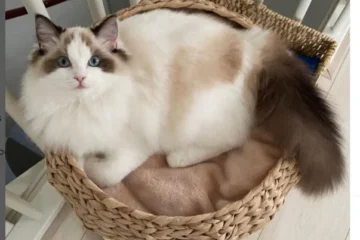
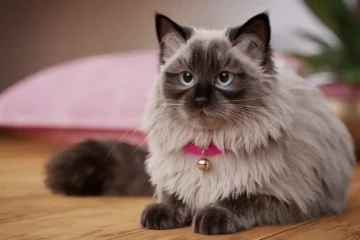
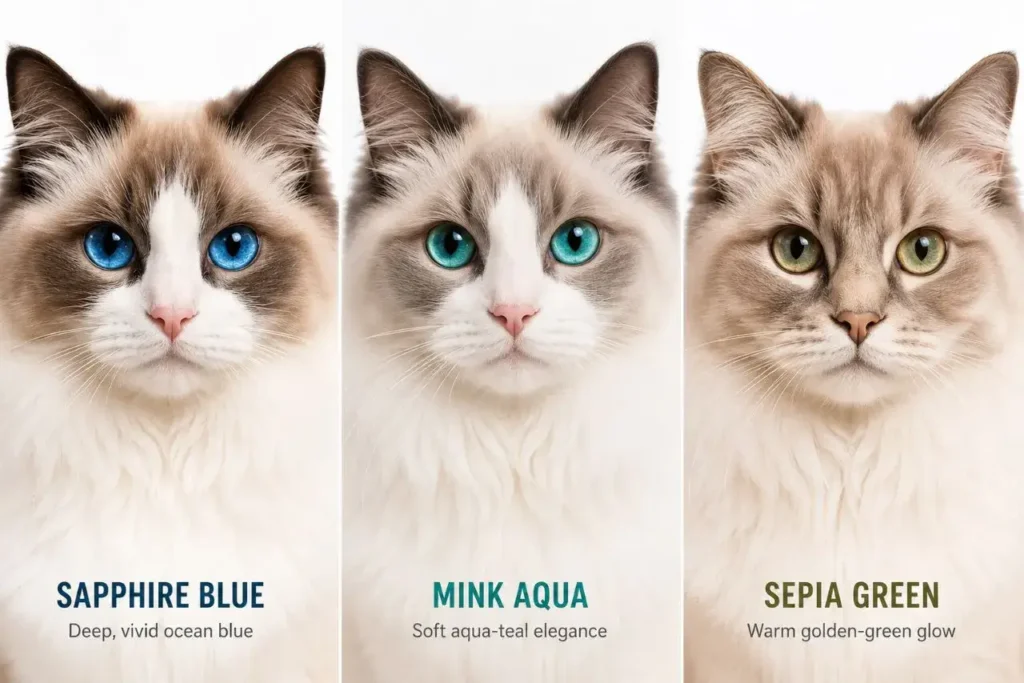
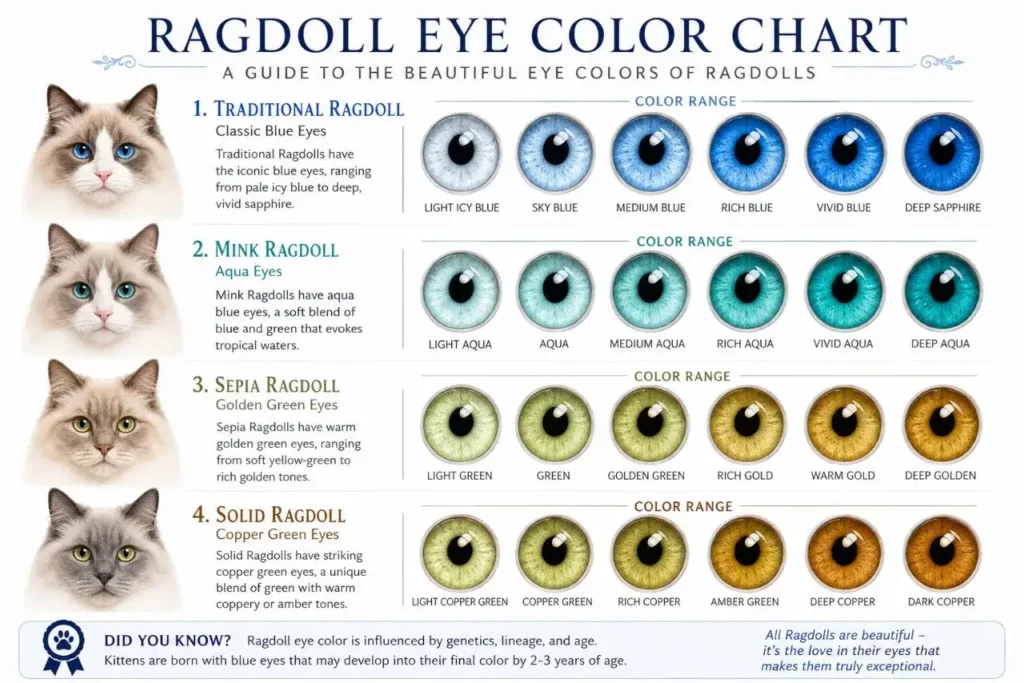
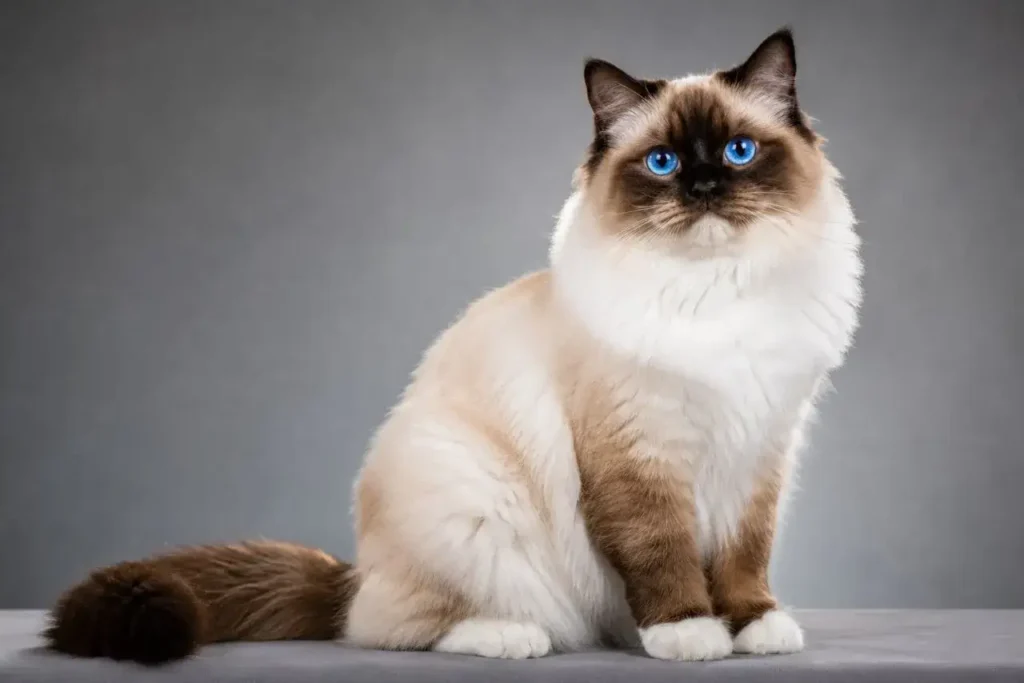
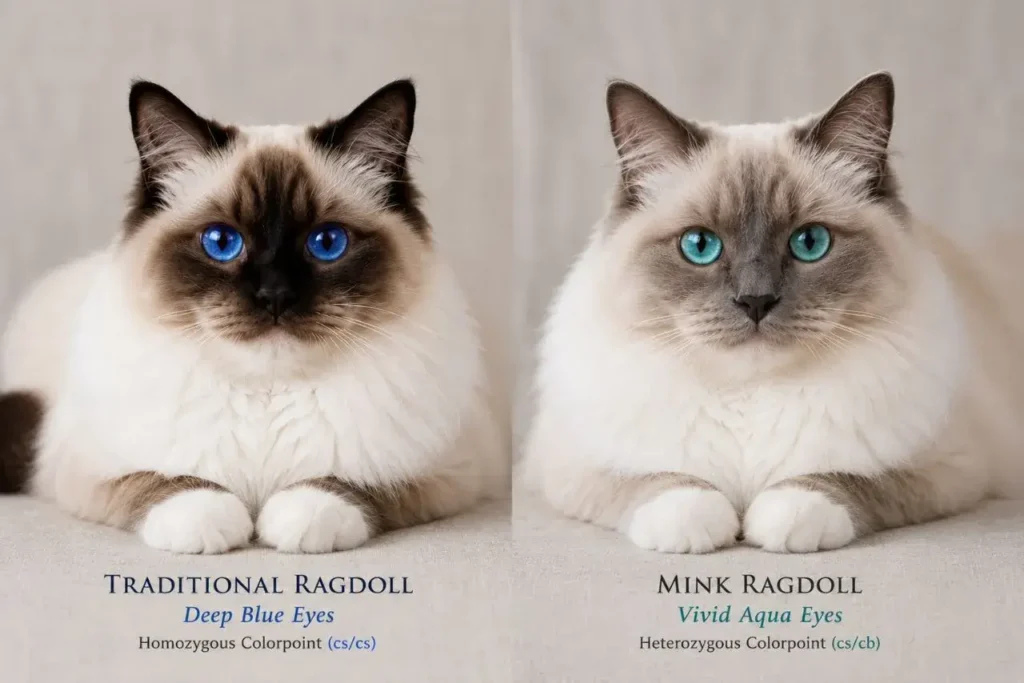
Traditional Ragdolls will always have blue eyes. The eyes may range in color from ice blue to dark navy. Large blue oval eyes are one of the defining characteristics of the breed.
But that’s only half the story. Ragdolls come in three genetic varieties: traditional (pointed), mink, and sepia. And each one has different eye color possibilities.
All traditional Ragdoll kittens are born pure white and will have blue eyes. All minks, sepias, or solid Ragdolls will be born with color and varying eye colors.
So if someone tells you “all Ragdolls have blue eyes,” they’re technically only talking about traditional pointed Ragdolls. Mink and Sepia Ragdolls play by different rules.
If you’re curious how eye color connects to coat type, the Pure White Ragdoll Cat is a good example of how the same breed can look dramatically different depending on genetics. Bookmark this ragdoll eye color chart as your go-to reference when comparing cats by type.
Ragdoll cats have amazing eye colors, from deep blue to rare green and gold. Their eyes are a big reason why people love them. We’ll show you the secrets of the Ragdoll eye color chart in this guide. You’ll learn about genetics, factors, and rare colors that make their eyes stand out.
The Ragdoll Eye Color Chart: A Full Breakdown by Type
This is the core of what most people are searching for. Here’s how ragdoll eye color breaks down across the three main types:
Traditional Ragdoll Eye Color
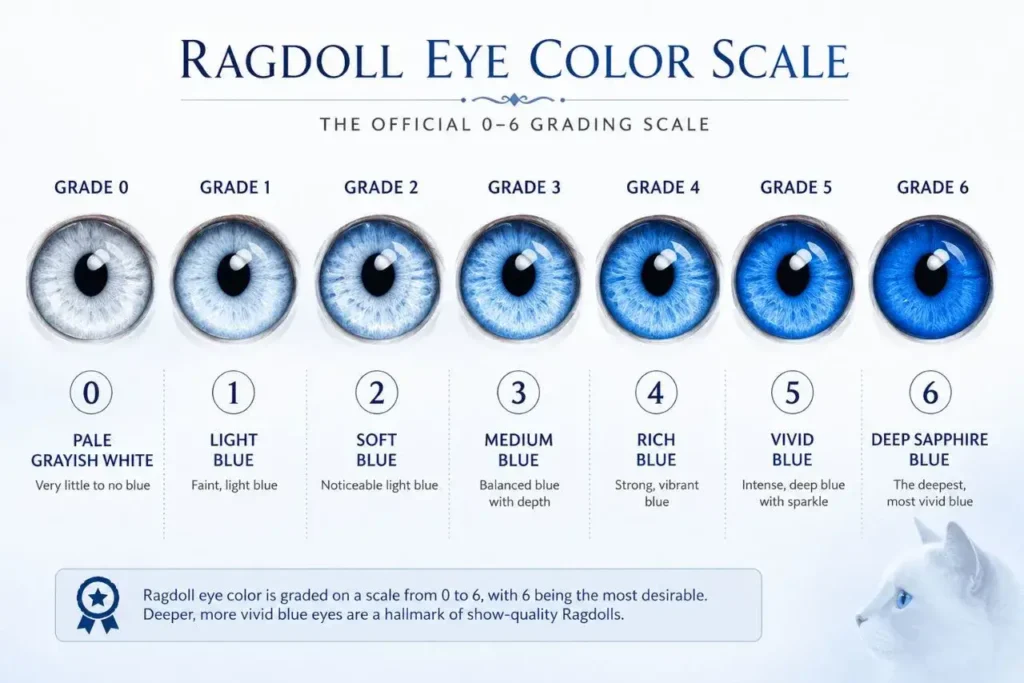
Traditional Ragdolls will always have blue eyes. The blue pigment of the Ragdoll eye is one of the reference standards for the appearance of the Ragdoll show, and the eye color is divided into 0-6 degrees.
The 0-6 grading scale works like this:
- 0: No blue pigment (a disqualifying fault in show cats)
- 1-2: Very light, almost pale blue or grayish
- 3-4: Medium blue, the baseline acceptable shows color
- 5: Deep, rich blue
- 6: Darkest sapphire blue, considered ideal for show quality
The deeper the blue, the higher the show score. A traditional Ragdoll with grade 5 or 6 eyes is considered superior in the show ring and will usually cost more from a reputable breeder.
The full genetics behind why this happens are covered in detail later in this guide.
Learning about Ragdoll eye colors is fascinating. It shows how special these cats are. Ragdolls are now the most popular cat breed. Their beautiful eyes are a big reason why.
Mink Ragdoll Eye Color
Mink Ragdolls can have blue eyes, but they may also have varying shades of blue-green all the way to deep aqua. It is often very difficult to determine the final eye color of mink kittens.
This is one reason Mink Ragdolls are so interesting. A blue point mink ragdoll eye color might look like a deep teal or bright aqua, which is genuinely different from the traditional blue. Mink Ragdolls have a slightly different gene expression due to carrying two copies of the mink gene (Cb), which affects both coat color and eye pigmentation.
The most common mink ragdoll eye color is aqua, which ranges from a soft blue-green to a vivid turquoise. Some mink Ragdolls do have blue eyes, but they’re typically a warmer or more saturated blue compared to their traditional counterparts.
Sepia Ragdoll Eye Color
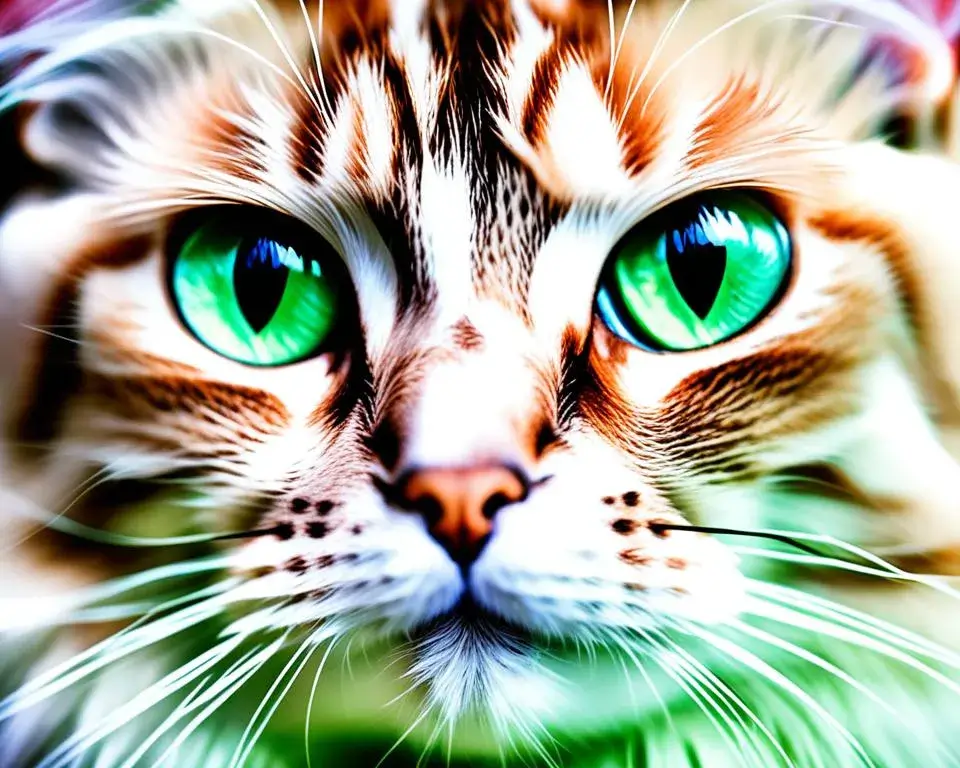
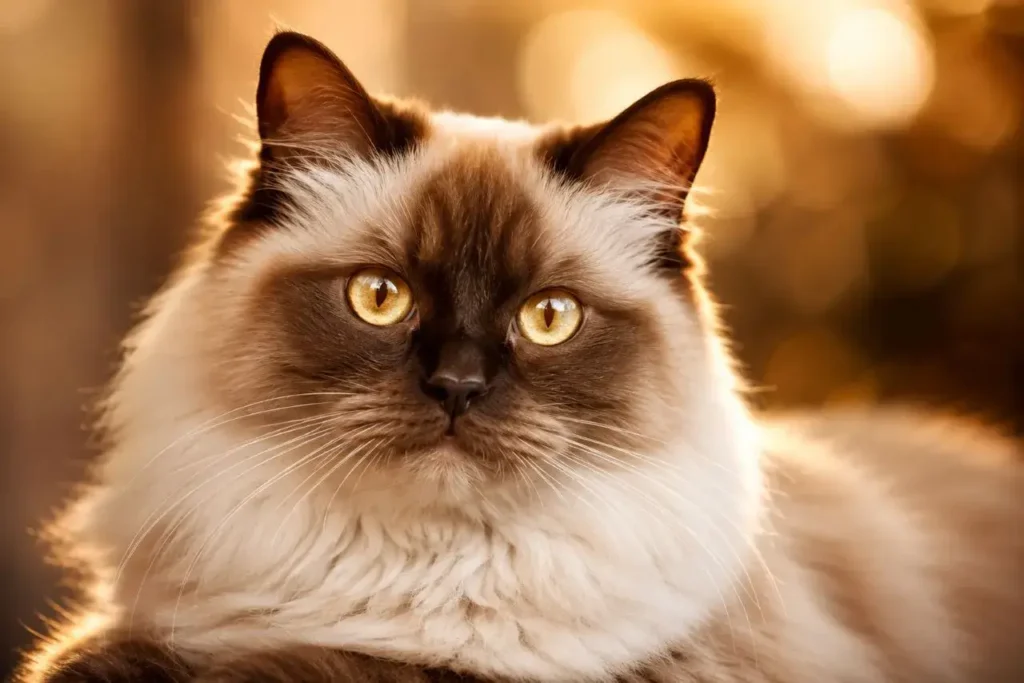
Sepia Ragdolls are notable for their lush coats that often darken with age. They have the most varying eye color of all Ragdoll cats. You’ll need to wait until they’re at least three months old to see what the final eye color will be. The eye colors can be shades of green, gold, aqua, brown, hazel, or blue.
Sepia Ragdolls carry two copies of the Burmese gene (Cb/Cb), which pushes eye color far outside the traditional blue range. You can genuinely get a Ragdoll with golden-green or hazel eyes if it’s a sepia. This surprises a lot of buyers who weren’t told their kitten was sepia.
Solid Ragdoll Eye Color
Solid Ragdolls are all one color and don’t have points. Their eyes can be green, copper, blue, or blue-green.
Solid Ragdolls are not recognized by CFA or TICA for show purposes, but they do exist within the Ragdoll gene pool. If you see a Ragdoll with copper or green eyes, it’s almost certainly a solid.
Ragdoll Eye Color Chart
The Ragdoll breed is known for its beautiful eyes. They come in many colors, from blue to rare shades. This chart shows the different eye colors of Ragdolls.
Most Ragdolls have blue eyes, which is what people expect. But some have green, yellow, or even brown eyes. These colors come from mixing different genes, sometimes making a Ragdoll look odd with two different eye colors.
| Eye Color | Prevalence | Genetic Factors |
|---|---|---|
| Blue | Most Common | Traditional pointed Ragdoll (cs/cs) |
| Aqua | Uncommon | Mink Ragdoll, now shown as Cherubim (cs/cb) |
| Green, Gold, Hazel | Rare | Sepia Ragdoll, a legitimate purebred variety (cb/cb), now shown as Cherubim |
| Copper, Blue-Green | Rare | Solid Ragdoll, also a purebred variety, now shown as Cherubim |
A common misconception is that anything other than blue means mixed breed. That’s not accurate. Green, gold, hazel, and copper eyes are the normal, expected result of sepia and solid genetics, both of which are purebred Ragdoll varieties with their own TICA classification, not signs of an impure lineage.
Factors Influencing Ragdoll Eye Color
Ragdoll cats have amazing eye colors. These colors come from their genes, coat patterns, and how they change with age. Knowing about these can help us see how unique Ragdoll eyes are.
The Role of Coat Patterns and Markings
Ragdoll cats’ coat patterns and colors affect their eye color. Cats with the classic colorpoint pattern often have deep blue eyes. Those with mitted or bicolor patterns might have aqua, green, or hazel eyes.
Age-Related Changes in Eye Color
Ragdoll kittens start with slate blue eyes. As they grow, their eyes can change to different colors. Some may turn yellow, amber, or even have odd-colored eyes. Watching these changes is part of their growth.
Learning about Ragdoll eye colors helps us see how special they are. It makes us appreciate their unique traits. It also helps with caring for these beautiful cats.
Identifying Rare and Unique Eye Colors
Ragdoll cats are known for their blue eyes, but they can have other rare colors too. These special colors, like green, gold, and odd-eyed cats, come from their genes and how their eyes are made. As a Ragdoll fan, I love seeing the different eye colors in this beautiful breed.
Green eyes are a rare find in Ragdolls. They’re also seen in breeds like the Russian Blue and Egyptian Mau. Golden or amber eyes are less common but still beautiful. You can see them in Ragdolls and other breeds like the British Shorthair and Bengal.
Odd-eyed Ragdolls are truly unique. They have one blue eye and another in green or gold. The reason for this look is still a mystery, but it’s linked to how melanin spreads in the iris. Breeds like the Turkish Van and Sphynx often have odd-eyed cats.
Ragdolls start white and get their colors, including eye color, as they grow. It can take up to 2 years for their full look to show. Colors like lilac and flame point Ragdolls are especially beautiful, adding to their charm.
As a Ragdoll owner, finding their unique eye colors is exciting. Whether it’s green, gold, or odd-eyed, these colors show how special Ragdolls are. They prove the breed’s genetic richness and beauty.
Ragdoll Kitten Eye Color Change: What to Expect and When
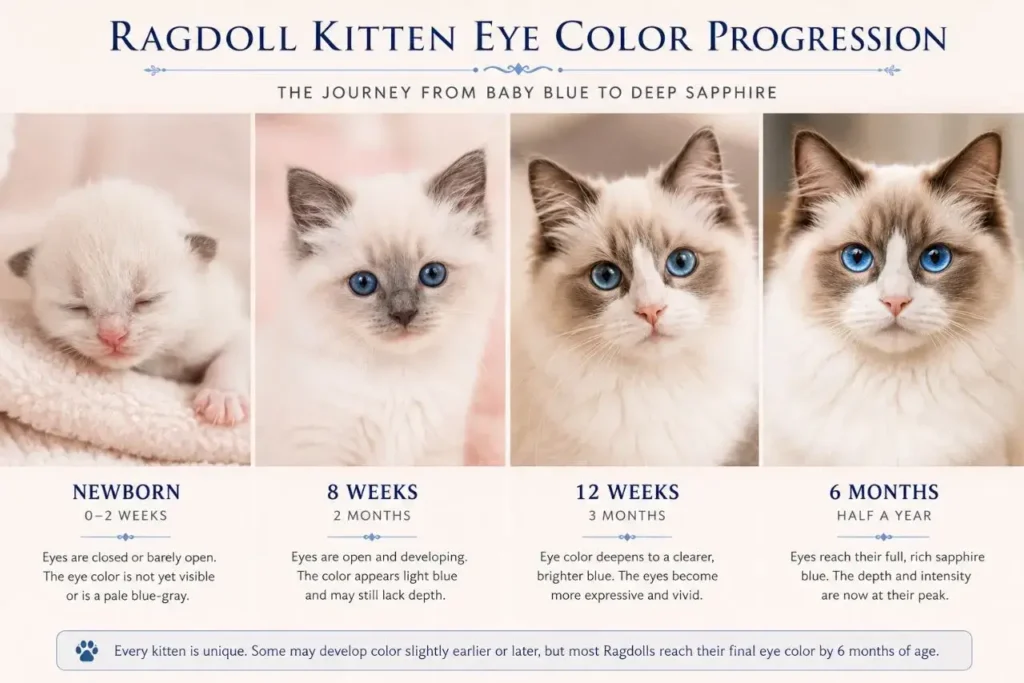
This is something that confuses a lot of new owners, and it’s one of the most searched sections of any ragdoll eye color chart. Your kitten’s eyes at 4 weeks are not going to be its permanent eye color. Here’s what actually happens at each stage:
Eye color at birth to 4 weeks
All newborn kittens, regardless of breed, are born with eyes closed. When they open at around 10-14 days, the eyes appear blue or gray. This is because the iris hasn’t developed its full pigmentation yet.
A kitten before 60 days old can’t show you its final eye pigment. Their eyes are covered with a blue membrane that usually fades in 45-60 days. After that, the true color appears and won’t change.
Ragdoll eye color at 8 weeks
By 8 weeks, traditional Ragdolls will still show blue eyes, but the shade starts to become more consistent. For mink or sepia kittens, you might start to see hints of aqua or green developing in the iris.
Ragdoll eye color at 12 weeks
By 8 to 12 weeks, we know the kitten’s color and pattern. The same applies to eye color for most traditional kittens. A 12-week-old traditional Ragdoll should have blue eyes that look close to their final shade. Mink kittens may still be developing.
Ragdoll eye color at 6 months
By 6 months, most Ragdolls have their settled eye color. Traditional Ragdolls should now show their true blue grade. Mink and sepia kittens usually have their final aqua, green, or gold color by this point.
Ragdoll eye color at 1 year
The eye color is fully set. Some owners notice a very slight deepening of blue in traditional Ragdolls during the first year, but by 12 months, you’re looking at the permanent eye color.
It’s worth noting that lighting makes a huge difference. The color of the eyes will change according to the environment. Facing the sun, the color will fade. Breeders usually use the color of a kitten indoors as the measure of eye color.
If you want to assess eye color accurately, do it in consistent, soft indoor light. Outdoor sunlight or bright flash photography will wash out even the deepest blue.
Why Do Ragdoll Cats Have Blue Eyes? The Genetics
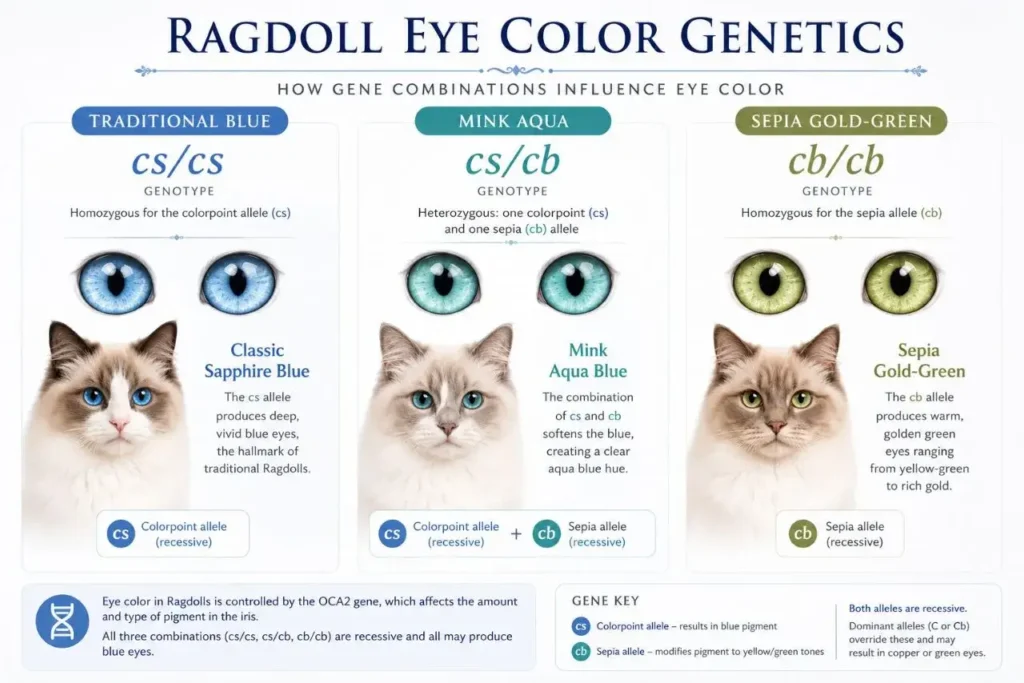
Ragdolls have blue eyes because of the same gene responsible for point coloration in cats: the Siamese gene (cs). This is a form of the albino series, and it causes partial albinism that restricts pigment from developing in the body’s extremities (which creates the darker points on ears, paws, and tail) and in the iris.
Because melanin production in the iris is suppressed, the eyes appear blue. The color you see is actually light reflecting off the back of the eye and scattering, the same basic reason the sky looks blue.
Traditional Ragdolls are homozygous for this gene (cs/cs), which is why every single traditional Ragdoll will have blue eyes without exception. Mink Ragdolls carry one Siamese gene and one Burmese gene (cs/cb), which is why their eye color lands in aqua. Sepia Ragdolls carry two copies of the Burmese gene (cb/cb), giving them the widest possible eye color range. Understanding this gene structure is the science behind every ragdoll eye color chart you’ll find online.
This is also why a Ragdoll Himalayan Mix Personality often produces kittens with blue eyes too, since Himalayans also carry the cs gene from their Siamese ancestry.
CFA and TICA Ragdoll Eye Color Standards
This matters a lot if you’re buying a show-quality cat or want to verify breed purity. It’s also one of the most practical ways to use a ragdoll eye color chart when evaluating a kitten.
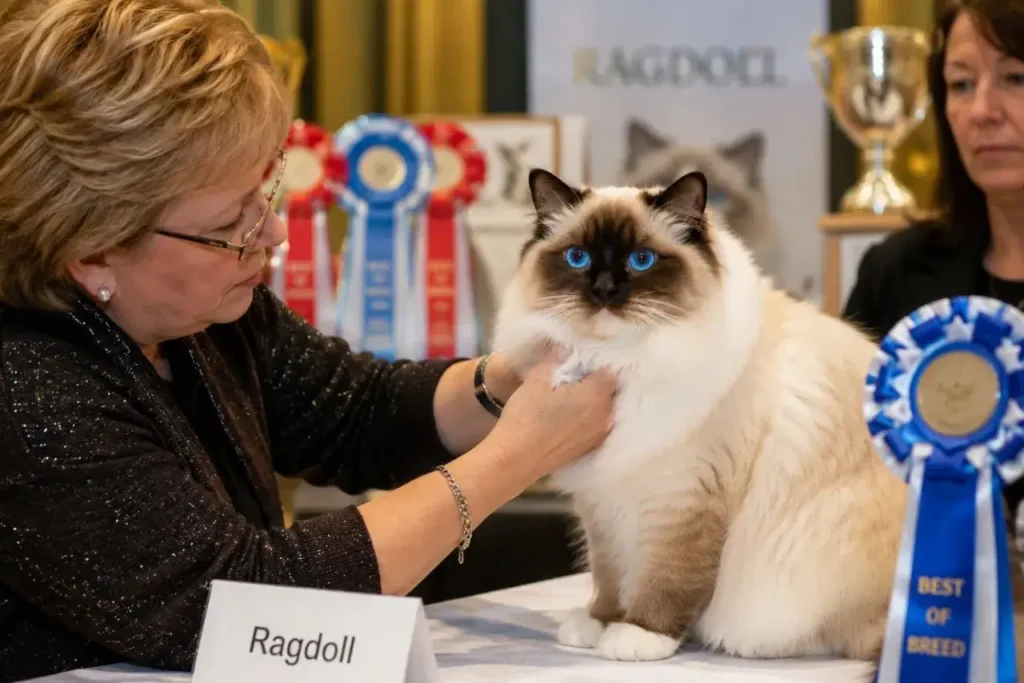
The CFA Ragdoll eye color standard requires that traditional Ragdolls have deep vivid blue eyes. Any color other than blue is a disqualification for traditional pointed Ragdolls in the show ring.
TICA’s rules changed in a meaningful way as of May 1, 2025: mink, sepia, and solid Ragdolls are now recognized for championship competition under a new classification called Cherubim, part of the same Ragdoll Breed Group as traditional pointed Ragdolls. Before that change, these non-blue-eyed varieties existed genetically but couldn’t compete for titles as Ragdolls. Now they have their own standard and can be shown, just under the Cherubim name rather than “Ragdoll.” CFA has not adopted an equivalent classification and still only recognizes the blue-eyed pointed variety.
The key thing to know: if you’re buying a cat labeled as a “traditional Ragdoll” and the eyes aren’t blue, something is off. It could be a mink, a sepia, or a mixed breed. A reputable breeder will be upfront about which genetic variety their kittens are.
Do All Ragdoll Cats Have Blue Eyes?
The direct answer: no. Only traditional pointed Ragdolls are guaranteed to have blue eyes.
Mink Ragdolls typically have aqua eyes. Sepia Ragdolls can have green, gold, hazel, brown, or aqua eyes. Solid Ragdolls can have green, copper, or blue-green eyes.
The myth that all Ragdolls have blue eyes comes from the fact that traditional Ragdolls dominate the market. Most Ragdolls sold by mainstream breeders are traditional pointed cats, so most buyers only ever see blue eyes. When someone ends up with a mink kitten whose eyes turn aqua, they think something went wrong. Nothing did.
If blue eyes are important to you, specifically ask your breeder for a traditional pointed Ragdoll and request to see the parents’ papers.
Ragdolls come in a wider variety of coats and color combinations than most people expect. The Ragdoll Tabby Cat Mix is a good example of how pattern variation can also affect what buyers expect versus what they get.
Eye Color by Coat Pattern: Seal, Blue, Lilac, Chocolate, and More
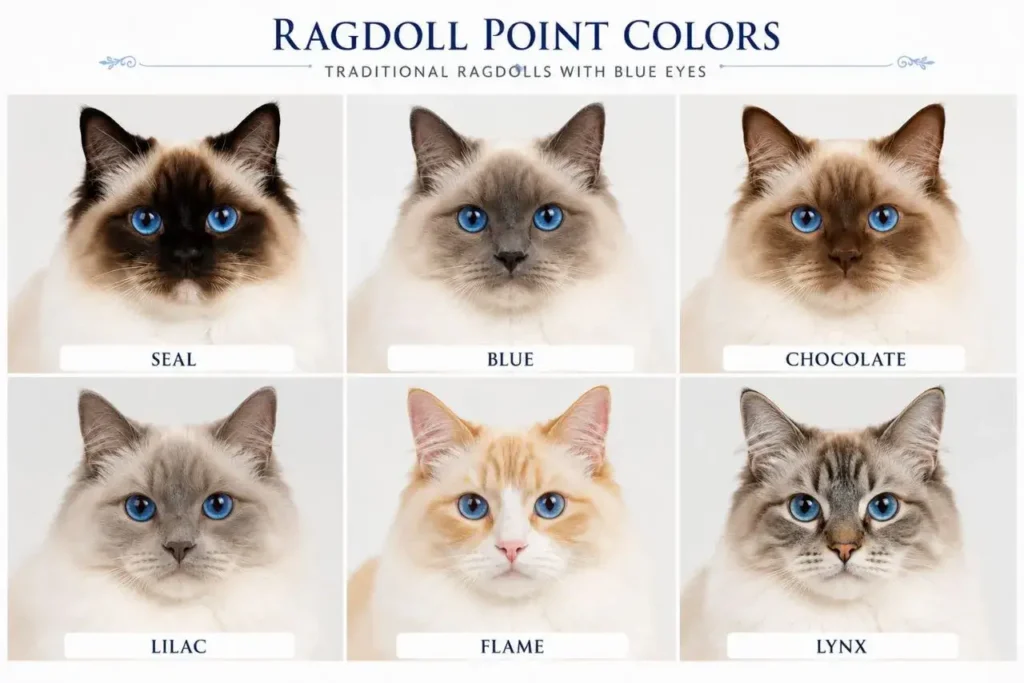
Coat color doesn’t determine eye color in traditional Ragdolls. Whether you have a seal point ragdoll eye color, blue point ragdoll eye color, lilac ragdoll eye color, or chocolate ragdoll eye color, the eyes will always be blue if the cat is traditional. The depth of that blue can vary, but the color itself doesn’t change based on coat. The table below is essentially a condensed ragdoll eye color chart organized by coat pattern:
| Coat Color | Genetic Type | Eye Color |
|---|---|---|
| Seal point | Traditional | Blue |
| Blue point | Traditional | Blue |
| Chocolate point | Traditional | Blue |
| Lilac point | Traditional | Blue |
| Flame/red point | Traditional | Blue |
| Cream point | Traditional | Blue |
| Lynx point | Traditional | Blue |
| Bicolor | Traditional | Blue |
| Seal mink | Mink | Aqua/blue-green |
| Blue mink | Mink | Aqua/blue-green |
| Seal sepia | Sepia | Green, gold, aqua, hazel |
| Solid | Solid | Green, copper, blue-green |
For bicolor ragdoll eye color specifically, the standard is still blue. The white chest, chin, and paws don’t change the eye color genetics since those cats are still traditional pointed Ragdolls underneath the white patterning.
The flame point ragdoll eye color also remains blue. Red or cream coloring in Ragdolls comes from a separate gene (the orange gene on the X chromosome) and has no effect on the cs gene that controls eye color.
If you’re curious about coat variety, the Tortoiseshell Calico Ragdoll Cat has some interesting coat genetics that overlap with this discussion, including how multiple color genes interact without affecting eye color in traditional cats.
Rare Ragdoll Eye Colors and What They Mean
Can ragdoll cats have green eyes? Can Ragdolls have yellow eyes? These are two of the most common questions people bring to a ragdoll eye color chart.
Yes, but only in specific genetic types. A traditional Ragdoll with green or yellow eyes is almost certainly a mixed breed. A sepia Ragdoll with green or gold eyes is completely normal and breed-standard for that variety.
Rare ragdoll eye colors include:
- Deep amber or gold: Found in sepia Ragdolls. Very striking but not common.
- True hazel: A mix of green and brown, seen in some sepia cats.
- Bright grass green: Seen in both sepia and solid Ragdolls.
- Odd eyes (heterochromia): One blue eye, one gold or green eye. This can occasionally appear in solid or mink Ragdolls and is considered a fault in traditional Ragdolls.
If your ragdoll kitten has green eyes and you were told it was a traditional Ragdoll, it’s worth asking for documentation. A purebred traditional Ragdoll won’t develop green eyes.
Ragdoll Eye Color and Breed Purity: What It Really Tells You
A lot of buyers assume that deep blue eyes automatically mean purebred. That’s not quite right.
Blue eyes in a Ragdoll tell you the cat carries the cs/cs gene combination, which is consistent with traditional Ragdoll genetics. But blue eyes alone don’t confirm purity. A domestic cat crossed with a Siamese or Birman could also produce blue-eyed kittens with Ragdoll-like coloring.
The real confirmation of breed purity comes from registration papers, pedigree documentation, and DNA testing if necessary. Eye color is a supporting data point, not the whole story.
That said, if a cat has aqua or green eyes and is sold as a traditional Ragdoll, that’s a red flag. Traditional Ragdolls do not have those eye colors.
For more on how coat color and genetics connect to breed identity, the Pure White Ragdoll Cat covers how color expression works across the breed, including why a white Ragdoll still carries the pointed gene.
Eye Color and Show Quality: What Breeders and Judges Look For
Show quality ragdoll eye color comes down to two things: the color must be blue (for traditional Ragdolls), and it must be as deep as possible. Any serious ragdoll eye color chart used by breeders reflects this grading directly.
The 0-6 grading scale used in many Ragdoll show circuits directly ties to price and breeding value. A kitten with grade 5 or 6 eyes from proven parents is worth significantly more than one with grade 2-3 eyes, even if everything else about the cats is identical.
Brightest blue ragdoll eyes, sometimes described as sapphire blue ragdoll eyes or deep navy, are what breeders and judges actively select for. Many breeders specifically pair cats whose eye color grades complement each other to try to push the genetics toward darker eyes in kittens.
The ragdoll eye color and price connection is real. A show-quality Ragdoll with deep sapphire eyes from a champion line can cost $3,000 or more, while a pet-quality kitten from the same litter with lighter eyes might be sold for $1,200-$1,500.
Understanding what affects a Ragdoll’s health and long-term development also matters when buying for quality. What is the Lifespan of a Ragdoll Cat is worth reading if you’re making a long-term investment in a show line.
Ragdoll Eye Health: What to Watch For
Blue eyes in Ragdolls are visually striking, but they come with a few health considerations worth knowing.
Ragdoll cat crossed eyes (strabismus): Some Ragdolls and other pointed breeds can develop a slight inward turn of the eyes. This is related to the cs gene and is generally cosmetic rather than medical in mild cases. Severe crossing affects vision and should be evaluated by a vet.
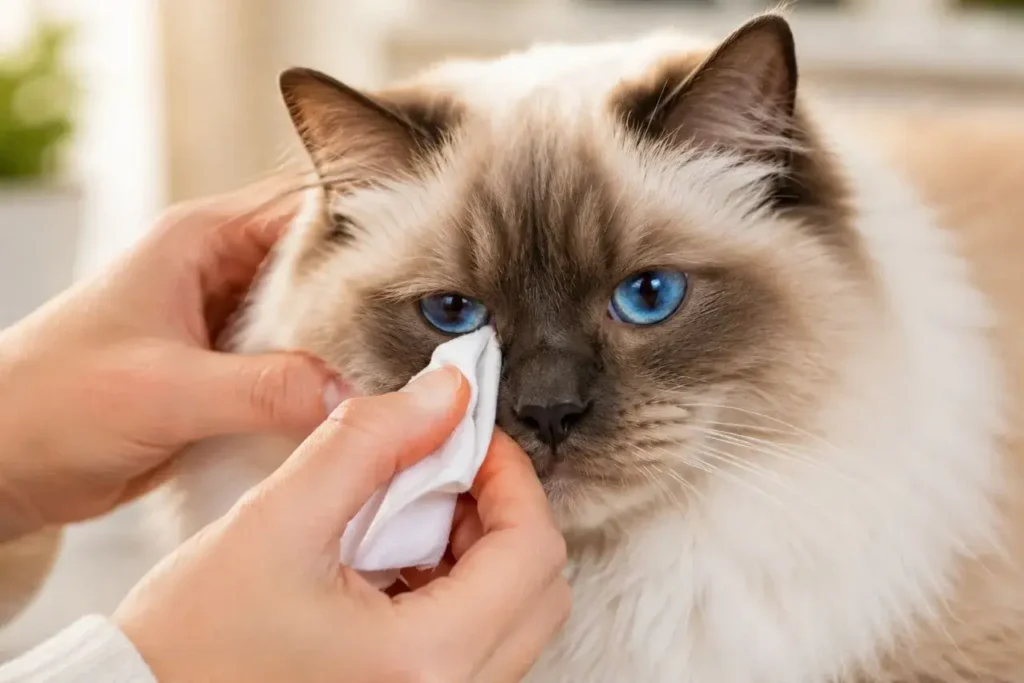
Ragdoll eye discharge causes: Regular, clear, or slightly cloudy discharge from the inner corner of the eye is common and usually normal. Colored discharge (yellow, green) signals infection. Ragdolls’ large, round eyes can also be prone to blocked tear ducts.
Cloudy eyes in Ragdoll cats: Cloudiness in the lens or cornea can indicate cataracts, uveitis, or other conditions. It’s not a normal part of aging in cats under 10. The Cornell Feline Health Center recommends prompt veterinary evaluation for any sudden changes in eye clarity. Have it checked promptly.
Ragdoll eye infection signs: Swelling, squinting, redness around the eye tissue, or any colored discharge. Ragdolls are generally healthy cats, but their eyes can be sensitive.
How to keep ragdoll eyes bright blue: You can’t change the genetic eye color, but keeping the area around the eye clean prevents staining and irritation. Wipe the inner corners gently with a damp cloth or specialized eye wipe every few days. Nutrition also matters. Some breeders believe a diet rich in antioxidants and omega-3 fatty acids supports better eye health overall.
If allergies are part of the picture for your cat, they can contribute to eye discharge and irritation. Ragdoll Cats and Allergies is worth a read if your Ragdoll has recurring eye issues alongside other symptoms.
Ragdoll Eye Color vs Other Breeds
When you put a ragdoll eye color chart next to similar pointed breeds, the differences become clear fast.
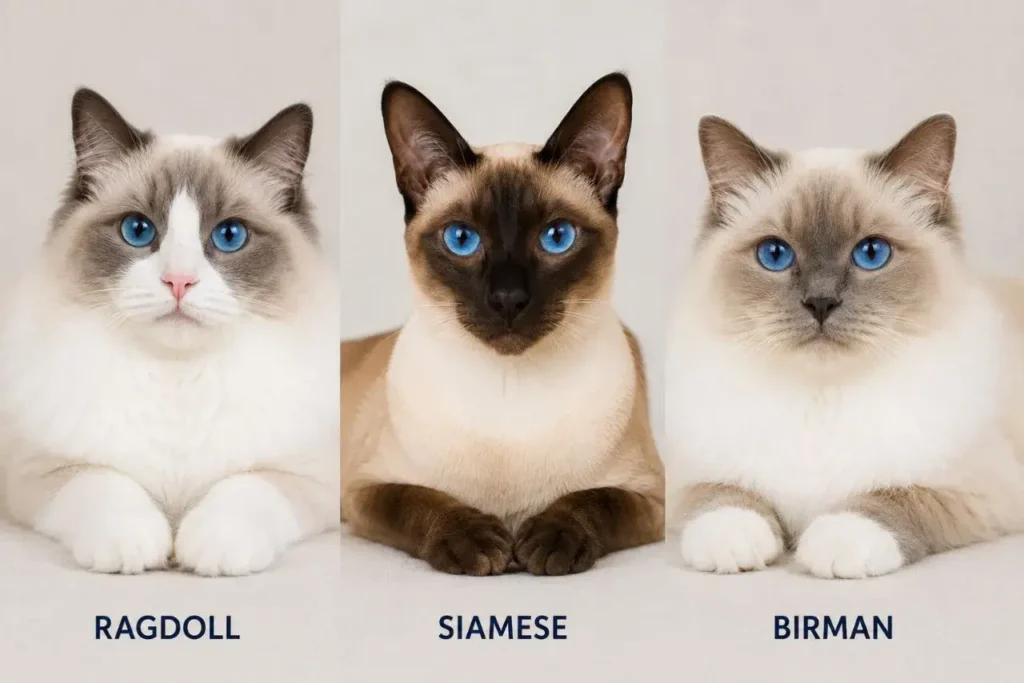
Ragdoll vs Siamese eye color: Both breeds rely on the cs gene, but Siamese eyes tend to be slightly more almond-shaped and can range from pale blue to a vivid intense blue. Ragdoll eyes are typically larger and rounder, and serious show-quality Ragdolls often display a deeper blue than most Siamese. The Ragdoll Cat Mixed With Siamese covers the crossover in detail, including how eye color genetics blend between the two breeds.
Ragdoll vs Birman eyes: Birmans also have blue eyes from the cs gene, but they tend toward a slightly lighter, more sky-blue shade compared to the deeper sapphire seen in top-quality Ragdolls. The Snowshoe Cat vs Ragdoll comparison also touches on eye color differences in these closely related pointed breeds.
Albinism and Ragdoll Eyes: Clearing Up the Confusion
The cs gene is part of the albino series, which leads some people to ask whether Ragdolls are albino. They’re not. True albino cats have no pigment anywhere, including the eyes, which appear pink or very pale lavender due to blood vessel visibility. Ragdolls have reduced pigment in the iris, but they still have some, which is what gives that blue color.
Albino ragdoll eye color (true albinism) would appear pink or very light red. If someone is selling an “albino Ragdoll” with blue eyes, that’s not an albino cat. It’s either a very light traditional Ragdoll or a marketing term being misused.
Ragdoll eye color and albinism are related only in the sense that they share a gene family. The actual expression is quite different.
People Also Ask: Ragdoll Eye Color FAQ
1. When do ragdoll kittens’ eyes turn blue?
Traditional Ragdoll kittens start with gray-blue eyes at birth and develop their true blue color between 6 and 12 weeks. The final depth of color is usually apparent by 3-4 months.
2. Why are my ragdoll cat’s eyes not blue?
If your cat was sold as a traditional Ragdoll but has aqua, green, or gold eyes, it may be a mink or sepia Ragdoll, or possibly a mixed breed. None of those are problems in terms of the cat’s health, but they affect breed classification.
3. Can ragdoll cats have green eyes?
Yes, but only sepia or solid Ragdolls. A traditional pointed Ragdoll will not have green eyes. If a traditionally pointed cat has green eyes, question the breeding.
4. Do darker blue eyes mean the Ragdoll is purebred?
Darker blue eyes are consistent with traditional Ragdoll genetics and are a positive indicator of breed quality in the show world. But eye color alone doesn’t confirm purity. You need proper registration papers.
5. What is a mink ragdoll eye color?
Mink Ragdolls typically have aqua eyes, a blue-green color that ranges from soft teal to vivid turquoise. Blue point mink Ragdolls eye color tends toward a slightly cooler aqua compared to seal mink Ragdolls.
6. Do ragdoll kitten eye colors change after 1 year?
No. Once a Ragdoll reaches 12 months, the eye color is set. The only thing that can make eyes appear lighter is environmental lighting or dilated pupils. The underlying pigment doesn’t change.
7. What ragdoll eye color is most desirable?
For show and breeding purposes, the deepest sapphire blue (grade 5-6 on the standard scale) is most desirable in traditional Ragdolls. For mink Ragdolls, a rich, vivid aqua is preferred.
8. At what age should I assess my ragdoll kitten’s eye color?
Wait until at least 10-12 weeks for traditional Ragdolls and 3-4 months for mink or sepia kittens. Before that, the eyes are still developing their final pigment.
9. Are ragdoll cat eye color problems hereditary?
Strabismus (crossed eyes) in Ragdolls has a hereditary component and is linked to the same gene complex that causes blue eye color in pointed cats. Responsible breeders select against it.
10. Can a Ragdoll’s eye color tell me about its personality?
There’s no scientific link between ragdoll cat eye color, personality, and behavior. Eye color is purely genetic. A Ragdoll with pale blue eyes is just as likely to be gentle and docile as one with deep sapphire eyes.
11. Does Coat Pattern (Mitted, Bicolor) Affect Eye Color?
No. Within a traditional pointed Ragdoll, coat pattern (colorpoint, mitted, bicolor) and coat color (seal, blue, chocolate, lilac, and so on) have no effect on eye color, it’s blue regardless. What actually changes eye color is genetic type: traditional, mink, sepia, or solid.
12. Can You Predict a Ragdoll Kitten’s Eye Color Before Birth?
Not precisely, but you can predict a range. If both parents are traditional pointed Ragdolls (cs/cs), every kitten will have blue eyes. If one or both parents carry the mink or Burmese gene, a breeder who understands the parents’ genotypes can tell you which eye colors are possible in a litter, though not exactly which kitten will get which shade.
Sources and Further Reading
- The Cat Fanciers’ Association – Ragdoll Eye Color Standard
- The International Cat Association (TICA) – Cherubim Classification
- Cornell Feline Health Center – Feline Eye Health
This article is for general informational purposes and isn’t a substitute for advice from a licensed veterinarian, particularly regarding sudden changes in eye clarity or discharge.
Conclusion
The Ragdoll eye color chart comes down to this: traditional Ragdolls always have blue eyes, mink Ragdolls typically show aqua, and sepia Ragdolls can range from green to gold. The depth of blue in traditional cats is graded on a 0-6 scale, with deeper blue being more desirable for show purposes.
Ragdoll kitten eye color change is normal and expected. Don’t judge the final color before 10-12 weeks, and always assess eye color indoors under soft light for an accurate read.
If you’re buying a kitten and eye color matters to you, use this ragdoll eye color chart as your starting point, then ask the breeder specifically which genetic type the kitten is, and ask to see the parents. A good breeder will have that information ready without hesitation.
For more on how Ragdolls compare to similar breeds in temperament and appearance, the Ragdoll Cats and Allergies guide, and the Snowshoe Cat vs Ragdoll comparison are both solid next reads.
Ragdoll eye colors are truly amazing. They come in many hues and patterns. The famous blue eyes are a key feature of traditional Ragdolls, but the mink, sepia, and solid varieties, now shown as Cherubim, bring their own equally legitimate range of aqua, green, gold, and copper. Learning about Ragdoll eye colors helps us see how special each cat is. The Ragdoll Eye Color Chart shows how diverse they are. It’s great for both new and long-time Ragdoll fans.
When looking for a Ragdoll, remember there’s more to them than their eyes. They are known for being gentle, loving, and easy to get along with. The Ragdoll Eye Color Chart shows their beauty and uniqueness. It encourages us to enjoy the special qualities of these cats.